The Iron in Your Blood Was Forged in a Dying Star — Yes, Yours Specifically
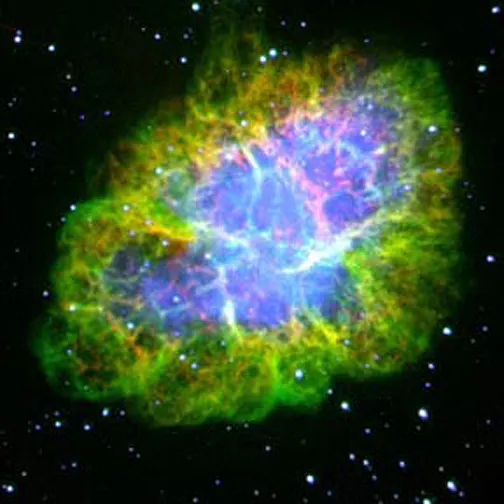
Photo: Palomar Observatory, Public domain, via Wikimedia Commons
Here's a fun thing to say at breakfast: the calcium in your orange juice, the iron in your cereal, and the oxygen you just breathed were all manufactured inside stars that died before the sun was born. This isn't a metaphor or a poetic flourish. It's a straight-up accounting of where atoms come from, and once it clicks, you'll never look at a grocery cart the same way.
The Universe Started With Almost Nothing
When the Big Bang cooled enough for atoms to form, the universe was essentially hydrogen and helium — the two simplest elements, about 75/25 by mass. That's it. No carbon. No oxygen. No iron. No calcium. A universe of hydrogen and helium can make stars, sure, but it can't make rocks, oceans, or people.
Every element heavier than helium had to be built afterward, inside stars, one nuclear reaction at a time. Astronomers call this process nucleosynthesis, but the mechanism is easier to picture than the name suggests: stars are fusion reactors, crushing light elements into heavier ones under staggering pressure and heat.
The Assembly Line Inside a Star
A massive star is basically an onion of fusion. In its core, hydrogen fuses into helium. When the hydrogen runs out, the helium fuses into carbon. Carbon builds oxygen, oxygen builds neon and silicon, silicon builds iron. Each new fuel burns faster than the last — a star that spent millions of years on hydrogen will burn its silicon in a matter of days.
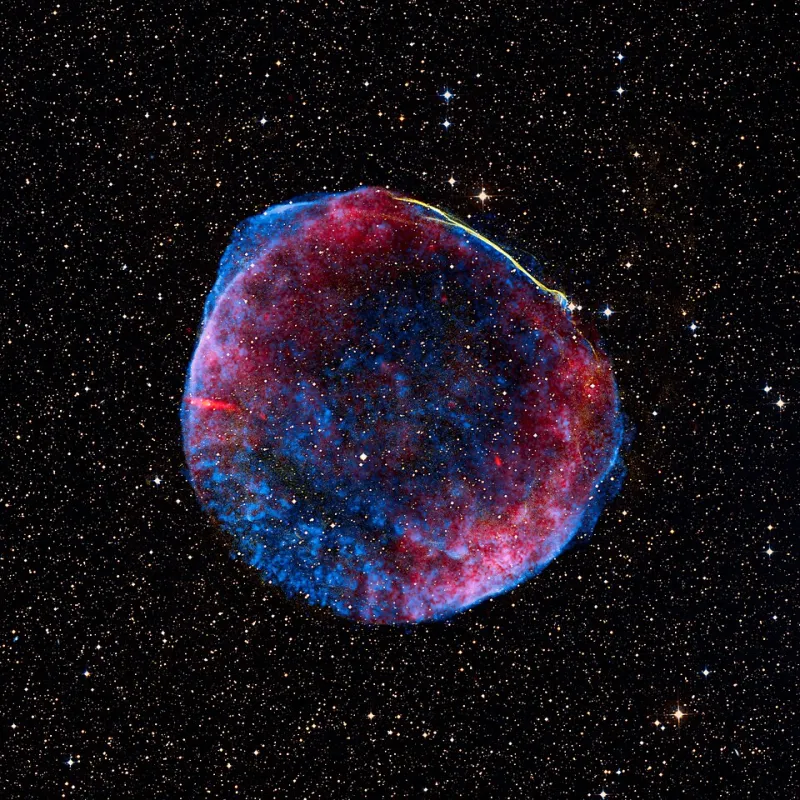
Then it hits the wall. Iron is the dead end of the periodic table. Fusing iron doesn't release energy; it consumes it. Without energy flowing outward, the core collapses in on itself in less than a second, and the resulting rebound — a supernova — briefly outshines the entire galaxy holding it.
And here's the beautiful part: that explosion, violent as it is, is also a delivery system. The shockwave and the intense neutron flux inside it forge elements even heavier than iron — gold, silver, iodine, uranium — and blast the whole cocktail of newly minted atoms out into interstellar space.
Your Personal Fossil Record
Now follow those atoms. They drift for millions of years through cold clouds of gas and dust. Eventually, one of those clouds gets heavy enough to collapse under its own gravity — and about 4.6 billion years ago, one such collapse became our sun, with a leftover disk of debris that became the planets.
That disk was rich in supernova debris. The iron in Earth's core? Forged in dying stars. The oxygen in the atmosphere, exhaled by ancient microbes but originally fused in stellar cores? Same story. The calcium that forms your skeleton, the iron that carries oxygen in your red blood cells, the iodine your thyroid needs — all of it was manufactured in stars that exploded tens of millions of years before our planet existed.
You are, quite literally, wearing the evidence. So is your breakfast. The iron in your cereal flakes and the iron in your blood are cousins — both traceable back to stellar furnaces.
Why This Matters Beyond the Wow Factor
Beyond being a great party fact, nucleosynthesis is one of the most practical tools in astronomy. Because each element absorbs and emits light at specific wavelengths, astronomers can read the chemical composition of stars and galaxies from thousands of light-years away. When they find a star with very little iron, they know it's ancient — born from a primordial cloud before earlier generations of stars had time to enrich the galaxy. Our sun, with its moderate iron content, is a middle-aged star in a well-seasoned neighborhood.
That's also how we know the universe has a history of stellar generations. The periodic table isn't just a chart on a classroom wall. It's a fossil record, layer by layer, of every star that lived and died before us.
So the next time someone tells you astronomy is abstract and far removed from daily life, hand them a glass of milk. The calcium in it crossed millions of light-years and billions of years to get there — one supernova at a time.