Signals in the Static: Five Cosmic Puzzles That Keep Astronomers Up at Night

Photo: brewbooks from near Seattle, USA, CC BY-SA 4.0, via Wikimedia Commons
Science isn't the stuff we know. It's the stuff we can't make behave. And right now, telescopes are collecting observations that refuse to fit neatly into anyone's equations. Some will turn out to be boring — a calibration error, a weird star, a dusty lens. But a few might redraw the map. Here are the ones researchers are actually losing sleep over.
1. Fast Radio Bursts: A Millisecond of Cosmic Shouting
In 2007, astronomers found a burst of radio energy from billions of light-years away that lasted about a millisecond — and packed the energy of the Sun's output over days. Fast radio bursts (FRBs) were so strange that for years many scientists assumed the detectors were glitching.
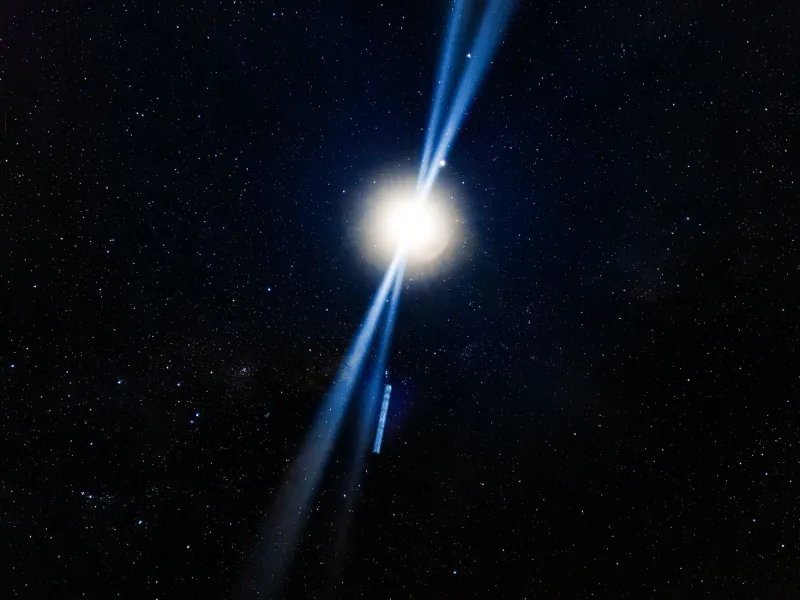
They weren't. We've now catalogued hundreds, and some repeat on schedules, like lighthouses. The leading suspects are magnetars — neutron stars with magnetic fields so violent they can rip themselves apart — but no single model cleanly explains every burst. Whatever's happening, it involves matter under conditions no lab on Earth can reproduce. Every FRB is a physics experiment we didn't design.
2. The Hubble Tension: The Universe Can't Agree on Its Own Speed
Measure how fast the universe is expanding using nearby supernovae and you get one number. Measure it using the afterglow of the Big Bang and you get a different number. The gap between them has narrowed as instruments improved — but it hasn't closed. Both measurements are now precise enough that 'someone made a mistake' is running out of room.
This is the Hubble tension, and it's the closest thing modern cosmology has to a smoking gun. Either something subtle biases one of the measurements, or the standard model of the universe — the one that's worked for decades — is missing an ingredient. New physics is on the table, and nobody's ruling it out.
3. Supernovae That Don't Know When to Quit
Stars that explode tend to follow a script: brighten over days, fade over weeks. Then astronomers found supernovae whose light curves looked nothing like the script — explosions that lingered for months, brightened in strange steps, or shone far too long for any known stellar corpse to power them.
The mundane explanations — odd chemical compositions, dust echoing the light — cover some cases. Not all. A few of these stubborn explosions hint at entirely new engines for stellar death, or at interactions between stars that physics textbooks treat as footnotes.
4. Stars That Went Dark Without a Farewell
In 2019, astronomers comparing old and new sky surveys noticed something unsettling: a star in another galaxy — hundreds of times the Sun's mass — was simply gone. No supernova. No farewell flash. Just a hole in the catalog.
One leading idea: some massive stars collapse straight into black holes without exploding at all. If that's true, we've been overcounting supernovae and undercounting black holes. But without a confirmed mechanism, 'failed supernova' remains a hypothesis wearing a mystery's clothes. Several other vanishing stars have followed, and the tally keeps growing.
5. The Universe's Coldest Cold Spot
Map the faint afterglow of the Big Bang and you'll find the temperature of the early universe is astonishingly uniform — with one glaring exception. A patch of sky in the southern constellation Eridanus is colder than it has any right to be, and larger than random chance comfortably allows.
Proposed explanations range from a genuinely enormous void in the structure of the cosmos to, more speculatively, a bruise left by a collision with another universe. The boring answer — a statistical fluke plus foreground dust — hasn't been fully ruled out. It also hasn't been fully confirmed. That unresolved tension is exactly what keeps the field honest.
Why the Weird Stuff Matters
Here's the pattern worth noticing: every one of these puzzles survived years of skeptical scrutiny. Detectors were checked, models were rerun, dull explanations were tested and discarded. What's left is a short list of places where the universe is quietly saying you haven't figured me out yet.
History says the payoff can be enormous — the last time astronomers found something that wouldn't fit, we ended up with dark matter and an expanding universe. Somewhere in this static, there may be another one of those hiding.