A Star Exploded in Broad Daylight and Europe Pretended Not to Notice
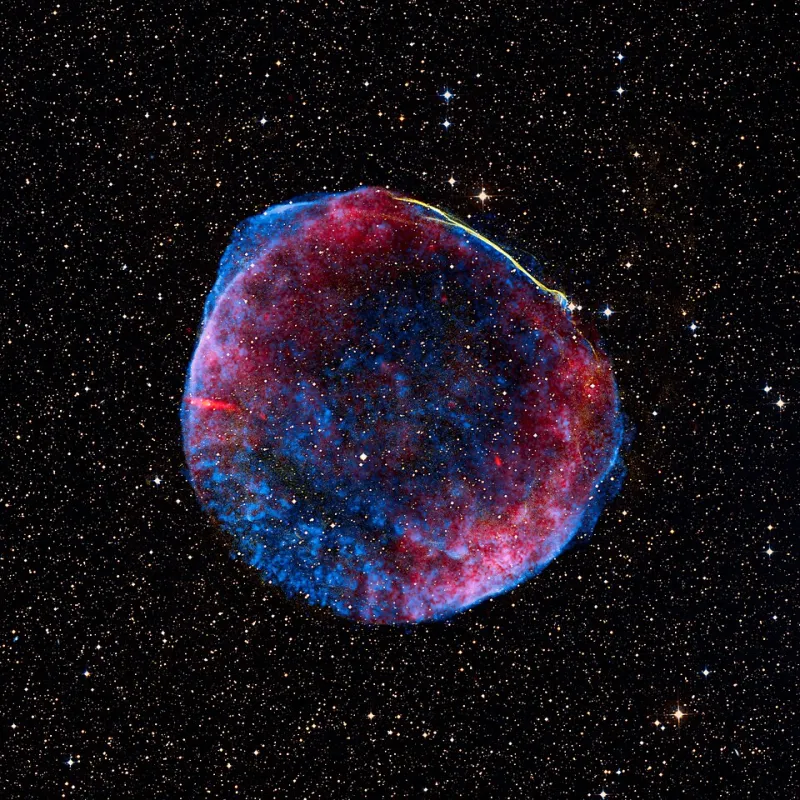
Photo: X-ray: NASA/CXC/Rutgers/G.Cassam-Chenaï, J.Hughes et al.; Radio: NRAO/AUI/NSF/GBT/VLA/Dyer, Maddalena & Cornwell; Optical: Middlebury College/F.Winkler, NOAO/AURA/NSF/CTIO Schmidt & DSS, CC BY 4.0, via Wikimedia Commons
In the spring of 1006 AD, something appeared in the southern sky that had no business being there. It was brighter than Venus. Bright enough, according to some accounts, to cast shadows at night and to be visible in daylight for weeks. It hung in the sky for months before fading away.
Chinese court astronomers recorded it precisely — position, color, duration. Egyptian observers logged it. Monks in Japan noted it. Even as far away as the American Southwest, petroglyphs in what's now Arizona may depict it.
And in Europe? Almost nothing. A few vague mentions in monastic annals, mostly describing an omen or a comet, if they mention it at all. The most advanced scientific institutions on the continent — the monasteries and cathedral schools that would eventually give us Copernicus and Kepler — looked at the brightest stellar event in recorded human history and declined to describe it.
This isn't just a curiosity. It's a case study in what happens when a society's framework for understanding the world can't accommodate the evidence in front of its eyes.
What Actually Happened in 1006
The event we now call SN 1006 was a Type Ia supernova — a white dwarf star, pushed past a critical mass by pulling material off a companion, detonating completely. These are the standard candles of modern cosmology; without them we couldn't have measured the universe's expansion. This one went off about 7,200 light-years away in the constellation Lupus, close enough by galactic standards to be spectacular.
The remnant is still there, still expanding, still glowing in X-ray images that look like a ghostly ring of fire. Modern astronomers have studied it so thoroughly it's practically a lab specimen.
The Chinese records, written by astronomers of the Song Dynasty, called it a "guest star" — kexing — and treated it as a matter of state importance. Celestial events in Chinese astronomy were political documents. A guest star in the wrong part of the sky could be read as a verdict on the emperor's performance, which meant the court astronomers had every professional incentive to record them accurately. Their records are so good that modern astronomers used them to pinpoint the supernova's location centuries later.
So Why the European Silence?
The honest answer is: the sky didn't fit the theory.
Medieval European cosmology, inherited from Aristotle and filtered through Church doctrine, held that the heavens were perfect and unchanging. Everything beyond the Moon's orbit was made of a fifth element — the quintessence — and nothing up there could be born, die, or change. Change belonged to the imperfect, mortal realm below.
A new star appearing in the sky wasn't just surprising under that framework. It was incoherent. There was no category for it. And when your worldview has no category for an observation, the path of least resistance is to not write it down.
It's worth being fair to the medieval monks here. They weren't stupid — many were brilliant observers and record-keepers. But their intellectual system had no slot for a changing sky, so the changing sky went largely unrecorded. The few European accounts that do exist tend to describe the object as an omen or a comet, which at least had a familiar box to fit into.
The contrast with Chinese astronomy is instructive precisely because it's not about intelligence or curiosity. Both civilizations had careful observers. One had a framework where a new star meant something. The other didn't.
The Pattern Repeats
SN 1006 wasn't unique. When Tycho Brahe observed his supernova in 1572 — still in Europe, still under Aristotelian assumptions — he famously noted that the new star had "no tail" and didn't move, meaning it couldn't be a comet and had to be in the region beyond the Moon. His careful measurement broke the old cosmology, and he said so. It took Europe another half-century of uncomfortable evidence to fully accept that the heavens change.
Notice what made the difference: by 1572, printing presses were spreading observations, and Brahe had instruments good enough to make a measurement that couldn't be waved away. The framework didn't change because people got wiser. It changed because the evidence got harder to ignore.
What This Has to Do With Us
Here's the uncomfortable part of this story, and the reason I think it's worth telling now.
We like to imagine we'd be the Chinese astronomers in this story — the ones who look up, describe what they see, and write it down. But consider the current state of the night sky for most Americans. Satellite constellations are streaking through every long-exposure photograph taken from ground-based observatories. Light pollution has erased the Milky Way from the view of roughly 80% of people in the United States. The sky that your grandparents knew is visibly, measurably different from the one over your driveway tonight.
And we are, mostly, not writing it down either. Not in the sense of court astronomers — in the sense of a society treating it as a matter of record, of consequence, of state importance. The satellites went up. The stars went out. Nobody's annals flagged it as an event.
This isn't a screed against technology — the same satellites delivering broadband to rural America are part of a genuinely good story. It's an observation about categories. Like the medieval monks, we don't record what our framework doesn't accommodate. A slightly dimmer sky doesn't have a box in the news cycle. So it doesn't get counted.
The lesson of 1006 isn't "medieval people were bad at science." It's that every civilization has blind spots shaped by what it already believes, and the test of a good one is whether it can build a new category when the sky insists on it. The Song Dynasty astronomers did. The monasteries took five hundred years.
We're still taking the test. The question is which kind of observers we turn out to be.