Follow One Carbon Atom Across Nine Billion Years and You End Up in Your Own Backyard
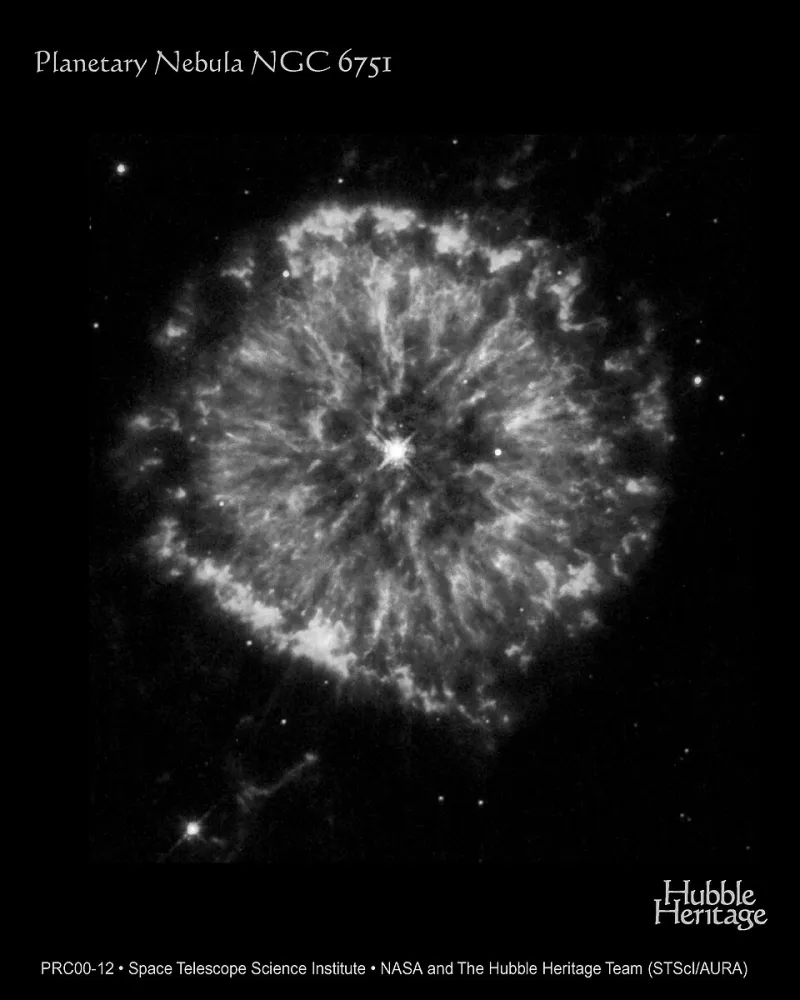
Photo: NASA, The Hubble Heritage Team (STScI/AURA), Public domain, via Wikimedia Commons
There's a carbon atom in your body right now — thousands of them, actually, in every cell — and it has a résumé that would embarrass any of us. It's been through at least one stellar death. It may have drifted through an interstellar cloud for millions of years. It's almost certainly been part of something else alive before it got to you.
Let's follow one of these atoms home.
First, a Quick Refresher on Where Atoms Come From
The universe started out remarkably boring, chemically speaking. After the Big Bang, there was hydrogen, some helium, and a whisper of lithium. That's it. No carbon. No oxygen. No iron. Everything on the periodic table beyond those first three elements had to be built later, inside stars, one fusion reaction at a time.
Astronomers call this stellar nucleosynthesis, which is a fancy way of saying stars are element factories. Hydrogen fuses into helium. Helium fuses into carbon. In massive stars, the process keeps going — oxygen, neon, silicon — right up to iron, where fusion stops paying its own bills and the star collapses in on itself.
The point is this: the carbon in your body wasn't made by the Sun. The Sun is too young and too small to have gotten that far. It was made by an earlier generation of stars, stars that lived and died before our solar system existed.
Our Atom's First Life: Inside a Dying Star
Picture a star roughly five billion years before the Sun switches on. Bigger than the Sun — say, three or four solar masses — burning through its fuel with the reckless confidence of a star that never expects to run out.
Deep in its core, our carbon atom is born. Three helium nuclei slam together in a reaction that only works because of a lucky quirk of quantum mechanics — a resonance level in the carbon nucleus that a famous astronomer once predicted had to exist, or we wouldn't be here to talk about it.
For a few million years, that atom sits in the star's core, drifting in a dense plasma hotter than anything you can picture. Then the fuel runs out. The star puffs off its outer layers in a slow, beautiful exhale — astronomers call it a planetary nebula, which is a terrible name for something that has nothing to do with planets — and our carbon atom rides that wind out into the galaxy.
It's free for the first time in millions of years.
The Long Wait in the Cold
The atom drifts through an interstellar cloud — a cold, thin fog of gas and dust light-years across. Temperatures hover around ten degrees above absolute zero. The atom spends a stretch of time stuck to the surface of a dust grain, then knocked loose, then stuck again.
This is the part of the story most people skip: between stellar generations, there's an enormous amount of nothing. Clouds take millions of years to collapse. Most atoms never get invited into a new star at all. Our atom gets lucky — a shockwave from a nearby supernova compresses its cloud, gravity takes over, and the whole thing starts falling inward.
That collapsing cloud becomes the Sun. And our carbon atom, along with a disk of leftover debris, becomes part of a small rocky planet in the third orbit out.
Earth. Roughly 4.5 billion years ago.
The Short Version: Rock, Ocean, Dirt, Dinner, You
Here's where the story speeds up, because once the atom reaches Earth, it starts cycling. It might spend a billion years locked in limestone on the seafloor. It gets dragged down a subduction zone, belched back out through a volcano as carbon dioxide, dissolved in rain, absorbed by a blade of grass in what's now Kansas.
A bison eats the grass. Eventually — after a few more rounds of this carousel — you eat something that ate something, and the atom ends up in a cell in your hand.
That's the whole journey. Star core, nebula, interstellar deep-freeze, protoplanetary disk, ocean floor, volcano, cornfield, dinner plate, you. Nine billion years, give or take, and it all happened so that a carbon atom could be part of the hand currently holding your phone.
Why This Isn't Just a Fun Fact
It's easy to file "we are stardust" under inspirational-poster material and move on. But the claim is literal and testable. The specific ratio of carbon isotopes in your body matches what stellar fusion produces. The iron in your blood was made in a supernova or a dying white dwarf. The calcium in your bones came from the same process.
Astronomers actually use this to study the galaxy. By measuring which elements are enriched in different star populations, they can reconstruct the history of star formation in the Milky Way — a forensic accounting of every generation of stars that came before the Sun. Our solar system's chemical fingerprint tells us it formed in a neighborhood with a healthy mix of supernova debris, which is why rocky planets like ours were possible at all.
In other words, the recycling program isn't a metaphor. It's the entire mechanism by which anything interesting exists.
The Part That Should Stick With You
The next generation of stars is already being born in clouds enriched by the deaths of the stars we can see tonight. Some of the atoms in your body will, in a few billion years, be part of something else — a new star's planet, maybe, or a nebula that someone's descendants photograph through a telescope.
You're not just looking at the universe when you're outside on a dark night. You're a sample of it, temporarily arranged into something that can look back. That's not poetry. That's just the chemistry, honestly reported.