A Hundred Billion Years From Now: The Slow-Motion Fate of Everything Around Us
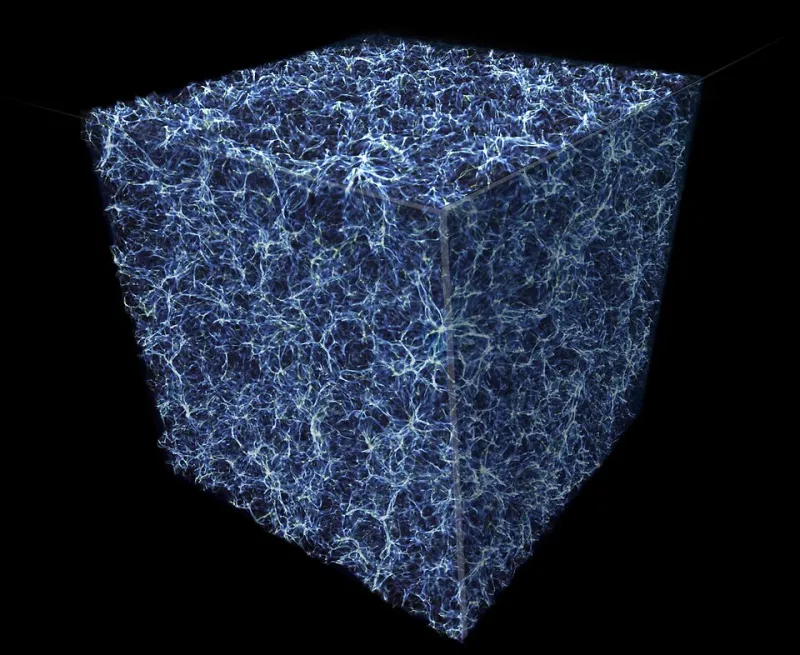
Photo: NASA, ESA, and E. Hallman (University of Colorado, Boulder), Public domain, via Wikimedia Commons
The universe is 13.8 billion years old. That number is almost impossible to hold in your head — it's roughly three times the age of Earth, and about a thousand times longer than complex animal life has existed on this planet. It feels like a long time.
It is not a long time.
When cosmologists talk about the ultimate fate of large-scale cosmic structures — superclusters, filaments, the whole gravitational architecture of the universe — they're working on timescales that make 13.8 billion years look like a warm-up act. We're talking hundreds of billions of years. Trillions. And on those timescales, the universe our descendants might observe (if any exist, and if physics still permits observation) will be almost unrecognizable.
So what happens to our supercluster? What's the long game for the Ursa Major Supercluster and everything gravitationally entangled with it?
The answer involves two forces pulling in opposite directions, a universe that's accelerating its own expansion, and a future that's simultaneously more dramatic and more lonely than you might expect.
Two Forces, One Outcome
To understand the fate of superclusters, you need to understand the two dominant forces shaping cosmic structure on the largest scales: gravity and dark energy.
Gravity, you know. It pulls things together. Over billions of years, gravity has been the architect of everything we see — drawing hydrogen gas into stars, stars into galaxies, galaxies into clusters, clusters into superclusters. It builds. It binds. It accumulates.
Dark energy is the other side of that coin, and it's been winning for the last several billion years. Dark energy is the name we give to whatever is causing the expansion of the universe to accelerate. Instead of slowing down after the Big Bang (as you might expect if gravity were the only player), the universe's expansion has been speeding up for at least the past five billion years. Distant galaxies are receding from us faster and faster, not slower and slower.
The critical question for the fate of any gravitationally bound structure is: which force wins locally? On the very largest scales — distances of hundreds of millions of light-years and beyond — dark energy wins, and structures are being pulled apart. But on smaller scales, where gravity is strong enough, structures remain bound and can continue to grow and merge.
Superclusters sit right at that boundary. And that makes their fate one of the most interesting problems in observational cosmology.
What's Happening to Our Supercluster Right Now
The Ursa Major Supercluster — our home in the large-scale structure of the universe — isn't a gravitationally bound object in the traditional sense. Unlike a galaxy cluster, which is held together tightly enough to resist the expansion of space, superclusters are loose, sprawling structures that may not be fully self-gravitating. Some cosmologists argue that our supercluster, like most, is in the process of being slowly pulled apart by dark energy even as gravity continues to draw its densest regions closer together.
The Virgo Cluster, which anchors our local region of the supercluster, is a different story. It is gravitationally bound, and the Local Group — the galaxy cluster containing the Milky Way and Andromeda — is falling toward it at hundreds of kilometers per second. In roughly 4 to 5 billion years, the Milky Way and Andromeda will merge into a single elliptical galaxy sometimes nicknamed Milkomeda. That newly merged galaxy will continue drifting toward the Virgo Cluster, eventually falling into it on a timescale of tens to hundreds of billions of years.
So locally, things are coming together. The densest gravitational knots in our supercluster are slowly coalescing.
The Isolation That Comes After
Here's where the story gets strange and a little melancholy.
As the universe continues to expand, the galaxies and clusters that are not gravitationally bound to our local region will recede beyond the cosmic horizon — the distance beyond which the expansion of space carries objects away faster than light can travel toward us. They don't disappear in a dramatic sense; they just become permanently unreachable and eventually unobservable.
Right now, we can observe galaxies tens of billions of light-years away. But in roughly two trillion years, a civilization in what remains of our galactic supercluster would look out at the sky and see almost nothing beyond their own immediate gravitational neighborhood. Every other supercluster, every other galaxy cluster, every other structure we currently catalog in our maps of the universe — gone beyond the horizon, forever.
What remains will be a gravitationally collapsed island: a super-galaxy or a collection of merged galaxies, surrounded by an increasingly dark and empty void. The large-scale structure of the universe — the cosmic web of filaments and voids that we can map today — will have dissolved into isolated gravitational islands, each one completely disconnected from the others.
Will Superclusters Merge — Or Just Come Apart?
The answer depends on which superclusters you're talking about and how close they are.
Our immediate cosmic neighborhood includes several major structures: the Virgo Supercluster (of which we're a part), the Coma Supercluster, the Perseus-Pisces Supercluster, and others, all loosely connected in the broader Laniakea Supercluster — a gravitational basin identified by astronomers in 2014 using galaxy flow data.
Whether Laniakea itself is gravitationally bound — whether its component superclusters will eventually merge — is still being debated. Current evidence suggests that dark energy is strong enough on those scales to prevent full collapse. The densest cores might merge; the outer regions will likely disperse.
On timescales of 100 billion years or so, the most likely scenario for our region of space is a partially merged super-structure: the Virgo Cluster and Local Group merged into a single massive elliptical galaxy, surrounded by other merged remnants of formerly distinct clusters, all embedded in a dark matter halo that spans millions of light-years. Call it a super-galaxy, a fossil cluster, or just the end state of local gravitational collapse.
The neighboring superclusters? Most of them will be beyond the observable horizon long before any merger could occur.
The View From the End
There's something almost philosophical about tracing these timescales. The stars in the Milky Way today will mostly be dead in a few trillion years — the longest-lived red dwarfs will sputter out around 10 trillion years from now. Any civilization watching the sky from a planet orbiting one of those last stars would see a universe almost devoid of observable structure: their own merged super-galaxy, a handful of gravitationally bound neighbors, and then darkness in every direction.
The cosmic web that we can map today — the extraordinary large-scale architecture of filaments, voids, and superclusters that took 13.8 billion years to build — will have been erased by the very expansion it grew inside of.
But gravity will have done its work locally. The densest parts of our cosmic neighborhood will be more tightly bound then than they are now. Smaller, denser, hotter — a gravitational remnant of everything that once stretched across hundreds of millions of light-years.
The universe builds things up and tears them down at the same time, on different scales, at different speeds. Where we sit right now — in a supercluster young enough to still be forming, in a universe old enough to have built everything we can see — might actually be the best seat in the house.