When Nothing Comes to Town: A Black Hole's Road Trip Through the Solar System
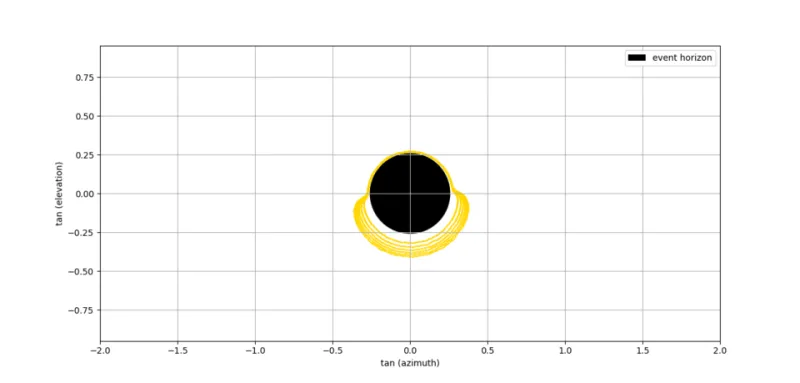
Photo: Cornelius Fyla, CC BY-SA 4.0, via Wikimedia Commons
Black holes have a reputation problem. Thanks to Hollywood, most people picture them as cosmic vacuum cleaners — hungry, indiscriminate, ready to slurp up anything that drifts too close. So when we say 'a black hole is coming to the solar system,' your brain probably jumps straight to Earth being stretched into spaghetti.
The reality is stranger, slower, and honestly more interesting. Let's run the scenario with a run-of-the-mill stellar-mass black hole — say, ten times the mass of the Sun — wandering in from interstellar space. Buckle up.
Phase One: The Wobble Nobody Notices
Here's the thing about a ten-solar-mass black hole: from far away, gravitationally speaking, it's basically a very dim star. Its gravity doesn't announce itself with fireworks. It announces itself with math.
Long before anyone sees anything, astronomers would notice it in the data. Planetary orbits are the solar system's most sensitive instruments. If something massive drifts in, the planets start tugging on it and it starts tugging back. Neptune's orbit would betray tiny deviations. Saturn's ephemeris would stop matching predictions by fractions of an arcsecond.
This is genuinely how we'd find out. Astronomers have already used exactly this logic to hunt for 'Planet Nine' — scrutinizing the weirdly clustered orbits of distant Kuiper Belt objects for the fingerprint of something unseen. A passing black hole would leave the same kind of breadcrumb trail, just louder.
Phase Two: The Un-Star
Once it's within telescope range, the black hole itself would be almost anticlimactic. It emits nothing. No light, no glow, no dramatic portal. What you'd actually see is what happens around it.
If it drifted through a dust cloud or happened to pass in front of a bright star, you'd get gravitational lensing — the background light bending around the invisible mass, smearing into arcs and duplicate images. For a few hours or days, one star in the sky might briefly appear as two, or stretch into a ring. Einstein predicted the trick; the black hole would just be performing it live.
Phase Three: The Solar System Reshuffles
Now the fun part. A ten-solar-mass visitor is ten times heavier than everything our Sun pulls on. Depending on its trajectory, the consequences range from 'unsettling' to 'apocalyptic.'
Best case: it passes through the outer solar system at high speed — several hundred kilometers per second is typical for stars in our galactic neighborhood. Fast flybys do less damage; there's less time for gravity to rearrange the furniture. We'd get comet showers as it scatters the Oort Cloud, icy bodies flung sunward over the following millennia. Spectacular auroras and meteor storms, but civilization limps along.
Worst case: a slow approach or a close pass by a giant planet. Gravity assists work both ways — the black hole could fling Neptune into a new orbit, eject Mercury from the solar system entirely, or nudge Earth's path enough to change our climate over centuries. You don't need to be swallowed to have a very bad time. You just need your orbit to change by a few percent.
And no, Earth wouldn't get 'sucked in' like in the movies. Orbital mechanics is about positions and velocities, not suction. The black hole would have to pass unnervingly close — within a few astronomical units — for us to spiral toward it, and even then the ending is a stretched orbit, not a movie-style plunge.
Phase Four: The Light Show (For the Unlucky)
If any matter does fall in — a shredded asteroid, a skimmed layer of the Sun, a very unfortunate comet — the finale is worth watching from a safe distance.
Infalling material doesn't drop quietly. It spirals, heats to millions of degrees from friction and compression, and blasts out X-rays before crossing the point of no return. A black hole feeding on the Sun's outer layers would light up the X-ray sky. Ironically, the most violent object in the universe is only visible when it's eating — the accretion disk outshines the darkness underneath.
So How Worried Should You Be?
Roughly zero. Stellar-mass black holes are sparse — we know of only a few dozen in the entire Milky Way, and the true population is maybe a hundred million scattered across a disk 100,000 light-years wide. The odds of one threading the needle into our solar system in the lifetime of the Sun are effectively nil.
But the thought experiment isn't pointless. It teaches you how gravity really works — that it's geometry, not suction; that orbits are conversations between masses; that the most consequential arrivals are often the ones you can't see at all. The universe's scariest objects don't chase you. They just change the shape of the space you're already falling through.
And that's somehow creepier than the vacuum cleaner.