The Last Dark Counties: America's Quiet War Over the Night Sky
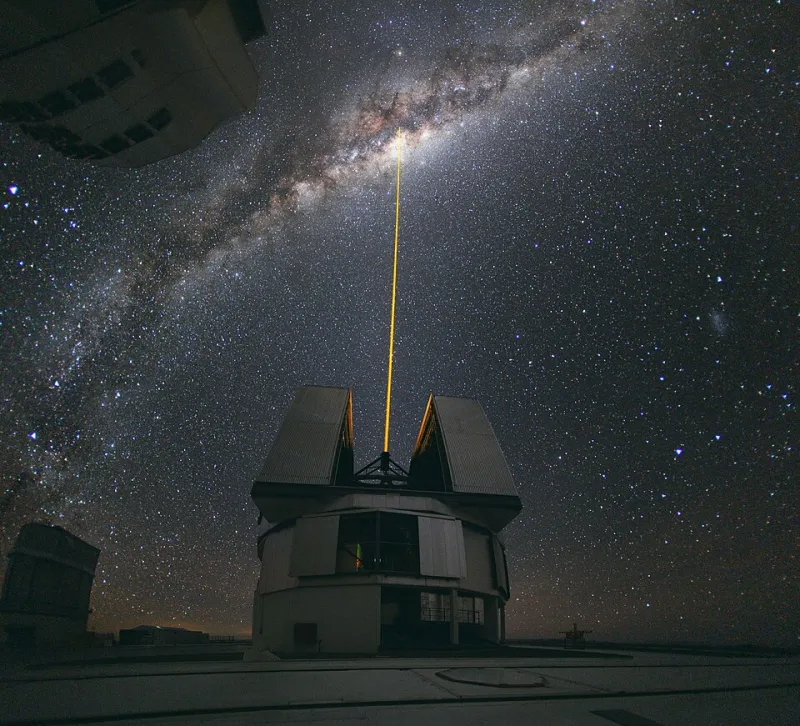
Photo: ESO/Yuri Beletsky (ybialets at eso.org), CC BY 4.0, via Wikimedia Commons
Stand on the Las Vegas Strip at midnight and look up. You'll see maybe a dozen stars. Drive four hours west into central Nevada and you'll find a sky so packed with stars it looks fake — the Milky Way throwing a shadow, planets casting faint light on the ground.
That four-hour drive is, in miniature, the story of America's relationship with the night. And right now, it's becoming a fight.
How We Lost the Stars
Light pollution isn't like other pollution. There's no smokestack, no discharge pipe — just billions of poorly aimed fixtures pushing light up instead of down. Satellite measurements show the night sky brightening roughly 10 percent a year in many places. That's not a slow drift; that's a doubling of skyglow in under a decade.
The toll goes beyond nostalgia. Migrating birds navigate by stars and get disoriented by city glow. Sea turtle hatchlings on Florida beaches crawl toward streetlights instead of the ocean. Nocturnal pollinators vanish from lit corridors. And researchers keep finding links between outdoor light at night and disrupted sleep, and possibly worse.
Then there's the quiet cost: we're raising a generation that has never seen the galaxy we live in.
The Southwest Fights Back
Here's the strange part — the counterattack is being led by some of the smallest communities in the country. Flagstaff, Arizona, passed one of the nation's first lighting ordinances back in 1958 to protect the observatories on its hills, and it remains the world's first International Dark Sky City. Towns across Arizona, Utah, and Texas have followed, adopting full-cutoff fixtures, amber LEDs, and curfews for decorative lighting.
The Dark Sky Place program has certified well over a hundred American sites now — state parks in Utah, a stretch of the Texas Hill Country, remote counties in Idaho and Oregon where the local economy now includes 'astro-tourism' alongside cattle.
Tribal nations have emerged as some of the most effective advocates. The Navajo Nation and other tribes have tied dark skies to cultural continuity — star knowledge, seasonal ceremonies, navigation traditions that lose their meaning when the sky goes blank. For these communities, protecting darkness isn't an environmental policy. It's protecting an inheritance.
The Economics Nobody Expected
The argument that actually flips city councils isn't about stars. It's about money.
Roughly a third of outdoor lighting in the US is wasted — aimed at the sky, doing nothing but generating a light dome visible from a hundred miles away. That's billions of dollars in electricity and millions of tons of carbon, annually, for literally nothing. Full-cutoff fixtures that send light down where it's needed are cheaper to run, and modern amber LEDs can be dimmed without turning streets into caves.
Even Las Vegas, improbably, has gotten into the act — retrofitting casinos and public spaces with fixtures that keep the Strip blazing while leaking far less light into the desert night. If Sin City can dim its skyglow, the argument goes, anywhere can.
Will the Milky Way Ever Come Back to the Suburbs?
Here's the honest answer: the light pollution already overhead doesn't vanish when you flip a switch. Skyglow lingers. But it fades faster than most people think once fixtures are corrected — and suburbs have a genuine shot at getting back the brighter half of the sky: the Moon, the planets, the bright constellations, the seasonal sweep of the Milky Way's core on a clear August night.
The changes are stubbornly simple. Shield the lights. Point them down. Use warm colors. Turn off what isn't needed. Every one of those is a decision a homeowner, a hardware store, or a small town can make tonight.
The night sky isn't gone. It's waiting four hours out of town — and, increasingly, a few towns over. All we have to do is look down at our light fixtures, and then look back up.