The Drinking Gourd: How One Star Pattern Became America's Most Important Map
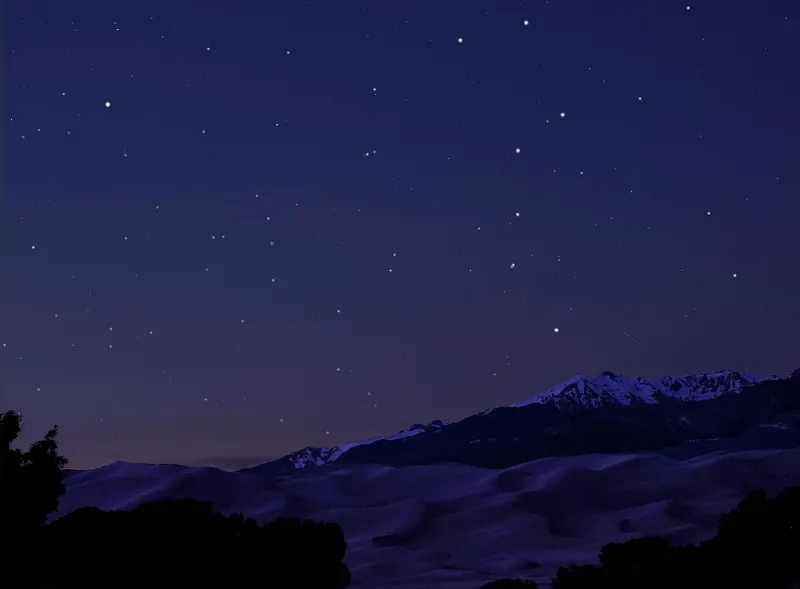
Photo: Great Sand Dunes National Park and Preserve, Public domain, via Wikimedia Commons
Ask most Americans what they know about the night sky and you'll get one answer: the Big Dipper. It's the first thing a parent points out, the first thing a scout troop learns, the asterism so embedded in our culture that it's on the Alaska state flag and the license plates of a dozen Western states.
We tend to file it under "charming trivia." I want to argue for something stronger: the Big Dipper is the most consequential star pattern in American history, and the knowledge of how to read it deserves to be treated as cultural heritage — not hobbyist fluff.
A Map When Maps Were Forbidden
Start with the most sobering chapter. For enslaved people in the American South, literacy was often illegal, and printed maps were dangerous to possess. But the sky was free, visible to everyone, and impossible for a plantation owner to confiscate.
A folk song, "Follow the Drinking Gourd," is often cited as encoding escape directions. The "drinking gourd" — the hollowed gourd used to scoop water — is widely understood to be the Big Dipper, whose bowl points toward Polaris, the North Star. Following it meant following north, toward freedom in the free states and Canada.
Historians still debate how widely the song functioned as a literal, coded instruction manual versus a later commemorative tradition — the version most people know was collected and arranged in the 20th century. But the underlying astronomy is not in dispute. The Dipper's pointer stars, Dubhe and Merak, aim directly at Polaris, which sits within about one degree of true celestial north. If you can find the Dipper, you can find north, any clear night of the year, anywhere in the Northern Hemisphere.
That's not a metaphor. That's a GPS with a battery life of billions of years.
The Same Trick Built the Country
What's striking is how many other chapters of American history run through the same seven stars.
Freedom seekers used it. So did the homesteaders who pushed across the plains in the 1800s, navigating trackless prairie where a fence post was the only landmark for fifty miles. So did the wagon trains on the Overland Trail, the surveyors who mapped township lines, and generations of sailors on the Great Lakes and along the Atlantic seaboard.
The pattern shows up in the cultural record everywhere you look. The Lakota and other Plains nations saw the bowl as a bear — the constellation we now call Ursa Major, the Great Bear, is the same stars under older names. Harriet Tubman, herself a navigator of the Underground Railroad, is famously associated with the North Star's use in escapes. The Boy Scouts and Girl Scouts have taught the pointer-star trick for over a century, and it remains one of the first requirements in most astronomy merit badges.
One asterism. Seven stars. Freedom routes, homestead claims, survey lines, state flags, and scout handbooks. Show me another star pattern with that résumé.
Why This Should Count as Heritage
We protect historic buildings, battlefields, and folk songs as cultural heritage. But the knowledge of how to navigate by the Dipper — knowledge that was passed down in whispers by people who could be killed for using it — rarely makes that list. It gets filed under "astronomy hobby" and left at that.
That feels like a category error. The ability to find north by the sky was, for a period of American history, a survival skill and, for some, the difference between bondage and freedom. It's knowledge with provenance, with stakes, with a story worth telling accurately.
There's also a practical case. Light pollution has made the Milky Way invisible to a third of Americans, and with it, the baseline skill of reading the sky is quietly evaporating. A kid who can find the Dipper and point to Polaris has a working compass they can never lose — and a direct, physical link to every generation before them who looked up and did the same thing.
So the next time you're under a dark sky, take thirty seconds. Find the bowl. Trace the pointer stars. Follow the drinking gourd. And remember you're not just doing astronomy — you're keeping alive one of the most consequential pieces of knowledge this country has ever passed along.