The Sky's Got a Schedule: Your Decade-by-Decade Guide to America's Next Great Celestial Shows
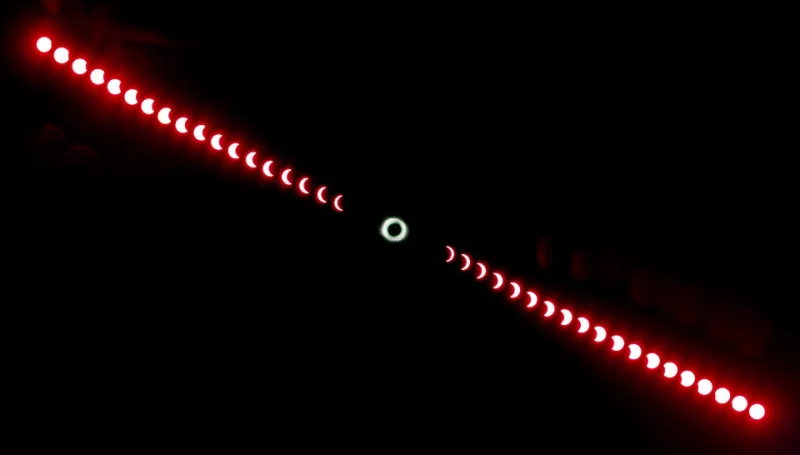
Photo: User:Kalan, CC BY 3.0, via Wikimedia Commons
If you stood in a Texas field or a New York park last April and watched the sun get swallowed whole, you've probably heard the phrase "next one is in 2044" tossed around like a sad footnote. Here's the thing: that's wildly misleading. The next twenty years are loaded with sky events that don't require a passport, a boat, or a heroic amount of luck. America is, frankly, in a golden era of celestial real estate. Let's walk through the calendar.
T Crux of the Matter: A Star Is About to Blow Its Top (Any Night Now)
Start with the strangest item on the list, because it has no date at all. Roughly 80 light-years away in the constellation Corona Borealis — a modest little arc of stars you can find by looking between Hercules and Boötes — sits a binary pair called T Coronae Borealis. One star is a red giant, bloated and dying. Its companion is a white dwarf, a dense cinder of a star that's been siphoning hydrogen off its neighbor for centuries.
Every 80 years or so, enough stolen gas piles up on the dwarf's surface to detonate in a thermonuclear flash. Astronomers call it a recurrent nova. The last eruptions happened in 1866 and 1946, and the signs since 2023 suggest we're due. When it blows, a star that's normally invisible to the naked eye will jump to brightness you can spot from a light-polluted suburb — a "new star" hanging in the Northern Crown for several nights.
No one knows if it's next month or five years from now. That's the fun part. Check the Corona Borealis region on clear evenings through spring and summer. If you see a star where none should be, congratulations: you caught an event that humans have witnessed perhaps a handful of times in recorded history.
Annular Eclipses: The Ring Shots Keep Coming
The "ring of fire" eclipses — where the moon covers the sun's center but leaves a blazing halo — are less famous than totality, but they're easier to catch and more frequent. The US gets more of them this decade:
- January 26, 2028 — an annular crosses the Gulf Coast and Florida's panhandle region.
- 2030–2035 — a series of partial and annular events clip the western states, with the Pacific Northwest getting particularly good partial coverage.
And don't sleep on deep partials. A 90%-covered sun is a genuinely weird experience — the light turns silvery, shadows sharpen strangely, and pets get confused. Solar viewers (the ISO-certified kind, please) cost a couple of dollars and last for years.
The Big One: April 8, 2044, Over the Northern Plains
Then there's the main event. On April 8, 2044 — exactly 20 years after the Texas eclipse — the moon's shadow will sweep across Montana, the Dakotas, and into Canada. Totality will pass over some of the darkest, most accessible prairie sky in the country. Think of it: flat horizons, vast open land, low humidity, and no need to fight coastal weather patterns.
Twenty years sounds distant until you remember people booked Texas hotels in 2017. If you want a ranch outside Rapid City or a cabin near Glacier for that week, the time to start planning is roughly now. Consider it a long-game gift to your future self — or your kids, who'll be old enough to actually remember it.
Why America, Though?
There's no cosmic conspiracy here. The 2020s through 2040s happen to be a stretch when the moon's shadow tracks favor the mid-latitudes of North America repeatedly, and when the 21st century's best-mapped eclipse paths crisscross the continent. Add in the T Crux Borealis nova, a couple of bright comet possibilities that always seem to surprise us, and the fact that large swaths of the American West still have genuinely dark skies, and you get a rare stretch where the best seat in the solar system is a folding chair in your own backyard.
The 2024 eclipse taught us something else worth remembering: the sky doesn't just reward people who travel to it. It rewards people who look up on an ordinary Tuesday, notice something's changed, and ask a question. The nova in Corona Borealis will be discovered — or confirmed — by exactly that kind of person.
So put the 2044 date in your phone. Keep a cheap pair of solar viewers in the glovebox. And every clear night this spring, spend thirty seconds glancing at that little crown of stars. Something up there is getting ready to make history, and unlike the eclipse, it won't even require you to drive anywhere.