Seventy Million Suns: The Monster Hiding Inside One of Our Closest Galactic Neighbors
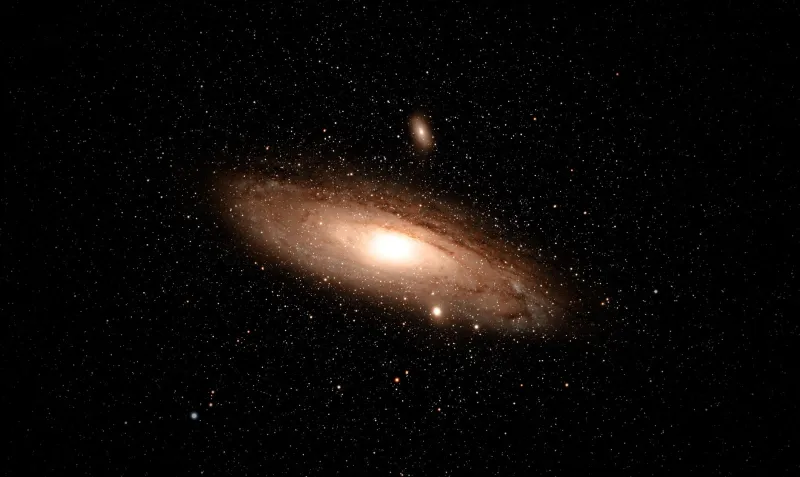
If you've ever pointed a decent telescope toward the constellation Ursa Major on a clear night, there's a good chance you've accidentally stared down the barrel of one of the universe's most violent engines.
Messier 81 — M81 for short, sometimes called Bode's Galaxy after the German astronomer Johann Elert Bode who catalogued it in 1774 — sits about 12 million light-years from Earth. That's practically next door by cosmic standards. It's bright enough that experienced backyard observers in dark-sky locations across the American Midwest and Southwest can pick it out with a modest telescope, and it photographs beautifully. Two sweeping spiral arms. A brilliant, compact core. The kind of galaxy that ends up as someone's desktop wallpaper.
But that gorgeous, serene appearance is a little misleading. Because right at the center of M81, something extraordinary is hiding.
What's Actually in There
At the heart of Messier 81 sits a supermassive black hole estimated to contain roughly 70 million times the mass of our Sun. To put that in some kind of human context: our entire solar system, every planet, every moon, every asteroid, every comet, the Sun itself — all of it — would be a rounding error compared to this thing.
Black holes of this scale aren't rare in the universe. Most large galaxies, including our own Milky Way, are believed to harbor a supermassive black hole at their centers. The Milky Way's central black hole, Sagittarius A*, weighs in at about 4 million solar masses — enormous by any human standard, but actually on the modest end of the supermassive scale. M81's black hole is nearly 18 times heavier.
What makes the M81 black hole particularly valuable to science isn't just its size. It's the combination of size, proximity, and behavior that makes it genuinely special.
How We Know It's There
Black holes don't emit light. You can't photograph one directly in the traditional sense — at least not easily. So how do astronomers know this particular monster exists, let alone measure its mass?
The answer involves some clever detective work that unfolds across multiple wavelengths of light.
One major line of evidence comes from observing how stars and gas near the galactic center move. Just like the way planets orbit faster when they're closer to the Sun, stars orbiting near a massive central object move faster than they should if there were nothing extraordinary there. By measuring those velocities with spectrographs — instruments that split light into its component wavelengths and reveal motion through subtle shifts — astronomers can calculate the mass of whatever is generating that gravitational pull.
For M81, those measurements have been refined over decades using ground-based observatories and space telescopes including the Hubble Space Telescope. The numbers consistently point to a central mass in the neighborhood of 70 million solar masses, far too concentrated to be explained by anything other than a black hole.
There's also radio wave evidence. M81's core is what astronomers call a "low-luminosity active galactic nucleus" — meaning the black hole is actively consuming material, just not at the frenzied rate of the most dramatic quasars in the distant universe. That activity produces detectable radio emissions, and very long baseline interferometry (VLBI), a technique that links radio telescopes across vast distances to simulate an Earth-sized instrument, has produced some of the most detailed images of M81's core ever captured.
An Active Engine, Running Quietly
Here's something worth sitting with for a moment. M81's black hole is actively feeding. Gas and dust spiral inward through what's called an accretion disk, heating up to extreme temperatures as it falls. Some of that infalling material gets redirected into jets of plasma that shoot outward from the black hole's poles at near-light speed.
This isn't unusual — a lot of galactic centers do something similar. But M81 operates at a relatively low level of activity compared to the blazing quasars astronomers observe in the distant universe. In some ways, that's exactly what makes it useful. Studying an extremely active quasar is a bit like trying to understand how a car engine works by staring at a drag racing engine running at full throttle. M81's black hole is more like a well-maintained engine idling in a driveway — still running, still doing interesting things, but calm enough that scientists can actually observe the details.
That relative calm has allowed researchers to study the relationship between the black hole and the surrounding galaxy in ways that are much harder to do with more violent systems.
The Black Hole and the Galaxy: A Two-Way Conversation
One of the bigger questions in modern astrophysics is the degree to which supermassive black holes and their host galaxies influence each other. This isn't just an academic puzzle — it gets at the fundamental question of how galaxies form and evolve over billions of years.
The emerging picture is that black holes and galaxies don't just coexist. They actively shape each other. When a black hole feeds aggressively, it can pump enormous amounts of energy back into the surrounding galaxy through jets and radiation. That energy can heat up gas clouds, slow down or even stop star formation, and fundamentally alter the galaxy's future trajectory. Scientists call this "feedback," and it appears to be one of the key mechanisms that determines why some galaxies are filled with young, hot stars while others are quiet and old.
M81 offers a relatively nearby, well-resolved example of this feedback process operating at a moderate intensity. Studying it helps researchers calibrate their models of how this dynamic plays out across cosmic time.
What Backyard Observers Are Actually Looking At
There's something quietly remarkable about the fact that M81 is an accessible target for amateur astronomers. Under dark skies — think rural areas away from city light pollution, maybe a camping trip to a national park in the American West — a 4-inch telescope can reveal M81 as a distinct fuzzy oval. Larger amateur telescopes begin to show the core's brightness and hints of structure.
When you look at that soft glow, you're looking at starlight that left M81 roughly 12 million years ago — back when our early human ancestors were still millions of years in the future. And right at the center of that ancient light, invisible but undeniably present, sits a gravitational titan that has been shaping its galaxy for billions of years.
Astronomy has a way of doing this — turning something that looks calm and beautiful into a window onto processes that are almost incomprehensibly powerful. M81 is a perfect example. It's one of the prettiest objects in the spring sky. It's also home to a black hole that outweighs 70 million of our Suns.
The universe, as always, contains multitudes.