Nobody Saw It Happen — But We've Been Watching It Ever Since
A Cosmic Crime Scene With No Witnesses
Somewhere in the constellation Cassiopeia, about 11,000 light-years from your front porch, a massive star ran out of road. Its core collapsed in a fraction of a second. The outer layers rebounded in a shockwave so powerful it briefly outshone entire galaxies. Then the light from that explosion — traveling at 186,000 miles per second — finally reached Earth sometime around 1680.
And as far as historians can tell, nobody noticed.
That's one of astronomy's most stubborn mysteries. The year 1680 wasn't exactly a dark age of sky-watching. European astronomers were actively mapping stars. John Flamsteed had just been appointed England's first Astronomer Royal. Telescopes existed. People were looking up. And yet there's no reliable record — no diary entry, no royal dispatch, no church document — confirming that anyone witnessed what should have been a spectacular naked-eye event.
One tantalizing clue: Flamsteed himself logged a faint star in Cassiopeia on August 16, 1680, that doesn't match any known star in that position. Some researchers think that might be it — a fleeting observation of the supernova already fading. But it's a thin thread, and the debate hasn't been settled in over a century of trying.
What we're left with is the wreckage itself. And it turns out the wreckage is extraordinary.
Meet Cassiopeia A
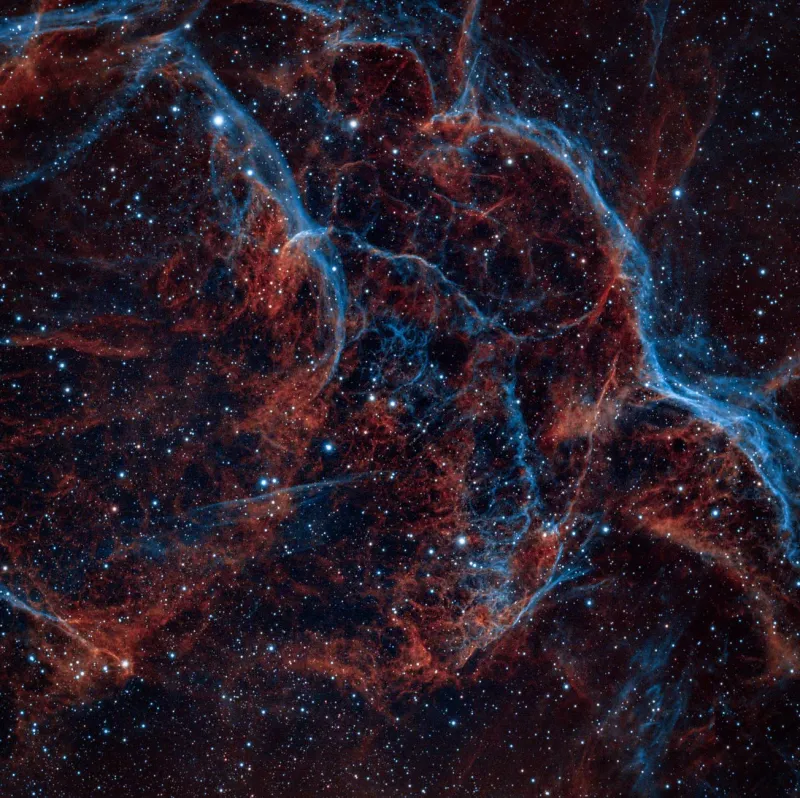
Cassiopeia A — Cas A for short — is what's called a supernova remnant. It's the expanding shell of gas and plasma that a dead star throws off when it explodes. Think of it as the shrapnel cloud still spreading outward from a detonation that happened three centuries ago.
Except this shrapnel cloud is about ten light-years across and still moving at roughly 14 million miles per hour.
When radio astronomers first detected it in 1947, Cas A turned out to be the brightest radio source in the sky outside our own solar system. That alone made it worth studying. But what's made it truly irreplaceable is that it's young enough — in cosmic terms — that we can still watch it change. We're not looking at a fossilized relic. We're watching an active process unfold in something close to real time.
What Modern Telescopes Keep Finding
Decades of observation have turned Cas A into a kind of multi-spectrum textbook. NASA's Chandra X-ray Observatory has been particularly transformative. X-ray images reveal the hot, shocked gas in the remnant's expanding shell with stunning clarity — swirling filaments, knots of ejected material, asymmetric jets of silicon and iron that tell us the original explosion wasn't a clean, symmetric burst. It was lumpy and directional, which gives astrophysicists clues about the mechanics of core-collapse supernovae that they can't get any other way.
The James Webb Space Telescope added a new layer in 2023 when it captured Cas A in infrared light, revealing structures and features that had been invisible before. Webb's images showed a complex inner region laced with glowing loops and strands of material — what NASA described as looking like "a tie-dye shirt" of cosmic debris. It was visually stunning, but also scientifically dense: those structures carry chemical fingerprints that help researchers understand exactly which elements were forged in the star's final moments and how they were distributed by the explosion.
And then there's the neutron star at the center.
The Dead Heart Still Ticking
When the original star's core collapsed, it didn't just disappear. It compressed into a neutron star — an object roughly the size of a city but containing more mass than the sun, spinning rapidly and radiating energy across the electromagnetic spectrum. Cas A's neutron star is one of the most studied objects of its kind.
In 2010, astronomers made a remarkable discovery: the neutron star was cooling faster than theoretical models predicted. That sounds like a minor technical discrepancy, but it actually pointed toward something significant — the possible presence of a superfluid of neutrons in the star's core. If confirmed, it would be direct observational evidence of a quantum mechanical state of matter that physicists had theorized but never directly observed in a natural setting.
That's the kind of finding that rewrites graduate school curricula. And it came from watching a dead star cool down.
A Living Laboratory for Stellar Death
What makes Cas A uniquely useful isn't just what it is — it's when it is. Most supernova remnants visible to us are either too old and diffuse to study in detail, or too far away to resolve properly. Cas A sits in a sweet spot: close enough that we can map individual structures within the remnant, and young enough that the physical processes driving its evolution are still clearly active.
Astronomers have used it to study how shockwaves accelerate cosmic rays — the high-energy particles that constantly rain down on Earth from across the galaxy. They've used it to measure how quickly heavy elements like iron, silicon, and sulfur are dispersed into the interstellar medium after a stellar death, which matters enormously for understanding how future stars and planets get their chemical ingredients. They've even used changes in Cas A's brightness over time to calibrate instruments on other telescopes.
In a very real sense, every time a new space telescope launches, Cas A is one of the first targets. It's the universe's quality-control standard.
The Mystery That Won't Quit
But circle back to that missing eyewitness account, because it's more interesting than it might seem.
When a star explodes in our galaxy, the expectation is that it should be visible — sometimes dramatically so. The supernova of 1006 was reportedly bright enough to cast shadows. The one in 1054 that created the Crab Nebula was observed by Chinese and Arab astronomers and remained visible in daylight for weeks. So why did Cas A apparently slip past every sky-watcher on Earth?
The most widely accepted explanation is dust. The line of sight from Earth to Cas A passes through dense regions of interstellar gas and dust that would have absorbed much of the visible light from the explosion, dimming it to near-invisibility even at its peak. The star may simply have been obscured by the galaxy's own material.
There's also the possibility that the progenitor star shed enormous amounts of material in the years before it exploded — a behavior seen in some massive stars — and that this surrounding shell absorbed the initial blast's visible light before it could escape. Either way, one of the most energetic events in our galaxy's recent history happened in near-silence, at least as far as human records are concerned.
Still Dying, Still Teaching
Cassiopeia A will keep expanding for thousands of years. The shockwave will gradually slow, the gas will cool, the neutron star will dim. Eventually it'll fade into the background hum of the interstellar medium, its material scattered across light-years, seeding the next generation of stars with the heavy elements it cooked up in its final moments.
But right now, in this narrow window of cosmic time, it's still bright enough to study, still dynamic enough to surprise us, and still close enough to examine in detail. Every new telescope generation finds something in it that the last one missed.
We didn't see it born. But we've got a front-row seat to everything that came after — and it turns out that's more than enough.