Ghost Stars in the Sky: How the Milky Way Quietly Tore Another Galaxy Apart
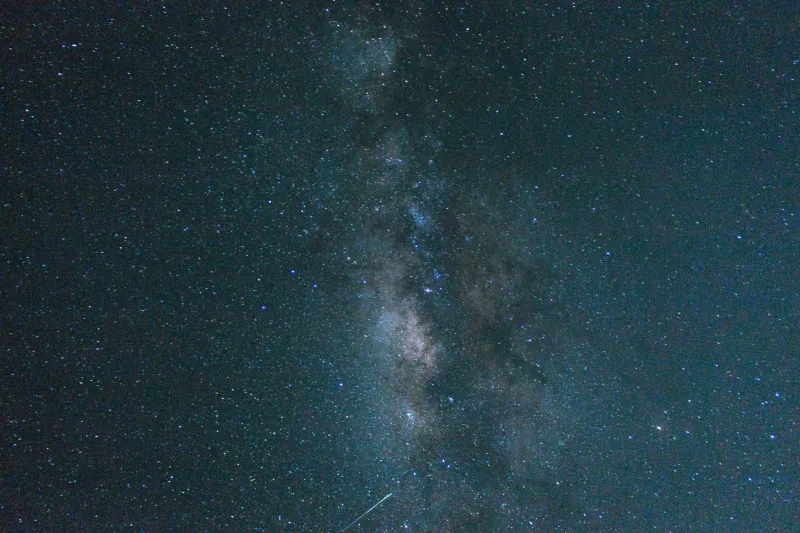
Look up at the night sky on a clear evening from anywhere in the continental United States, and you're seeing something that looks, at first glance, perfectly calm. Stars hang in place. Constellations hold their familiar shapes. The Milky Way — if you're lucky enough to be far from city lights — stretches overhead like a river of pale light.
But that stillness is an illusion. Buried in the math of stellar motion, threaded through the structure of our own galaxy like a scar, is evidence of something genuinely violent: a collision that's been unfolding for billions of years and isn't finished yet. The Milky Way has been dismantling a smaller galaxy piece by piece, and the wreckage is everywhere.
A Galaxy We Almost Missed
The Sagittarius Dwarf Spheroidal Galaxy — mercifully shortened to the Sgr dSph by astronomers who have places to be — wasn't discovered until 1994. That might seem surprising for something that's essentially inside our own galaxy, but there's a good reason it took so long. It sits almost directly behind the galactic center from our vantage point, buried behind billions of other stars and dense clouds of interstellar dust. Finding it required infrared observations that could cut through all that interference.
When astronomers Rodrigo Ibata, Mike Irwin, and Gerard Gilmore finally identified it, they weren't looking at a healthy, intact galaxy. They were looking at the remnants of one. The Sagittarius Dwarf is a galaxy in the process of being consumed — a gravitational meal that the Milky Way has been slowly eating for somewhere between one and three billion years.
The Art of Stellar Archaeology
So how do you prove that stars scattered across the sky used to belong to a completely different galaxy? This is where the detective work gets genuinely fascinating.
Every star carries a kind of chemical fingerprint. The ratio of elements baked into a star at its formation — iron, calcium, magnesium, and dozens of others — reflects the environment where it was born. Stars that formed in the Sagittarius Dwarf carry a slightly different chemical signature than stars that formed natively in the Milky Way. It's subtle, but it's measurable.
Beyond chemistry, there's kinematics — the study of how stars move. Stars that were gravitationally ripped from a smaller galaxy and dragged into ours don't immediately blend into the crowd. For millions of years, sometimes longer, they continue moving in ways that betray their origins. They travel in coherent streams, like a river running through a lake, maintaining a kind of orbital memory of where they came from.
Astronomers call these structures tidal streams, and the Sagittarius Stream is the most spectacular example we've found. It wraps around the entire Milky Way in a vast loop, stretching roughly 1.3 million light-years from end to end. In terms of sheer scale, it's one of the largest coherent structures associated with our galaxy.
What the Data Actually Looks Like
The Sloan Digital Sky Survey, a massive project that has mapped hundreds of millions of stars in precise detail, played a huge role in revealing just how extensive the Sagittarius Stream really is. When researchers plotted the positions and velocities of stars across the sky, certain clusters kept showing up with the wrong chemistry and the wrong motion for their location. They were outliers — stars that didn't belong where they were, statistically speaking.
Connect enough of those outliers and a picture emerges. Two major streams — a leading arm and a trailing arm — wrap around the galaxy in opposite directions, like ribbons unspooling from a central point. The core of the Sagittarius Dwarf still exists as a concentrated clump of stars near the constellation Sagittarius, but it's dramatically smaller than it once was. Each time it passes through the Milky Way's disk on its looping orbit — roughly every 550 to 750 million years — our galaxy's tidal forces strip away more material.
The Sgr dSph has probably made somewhere between three and ten of these passes already. With each orbit, it loses mass. With each orbit, the Milky Way gains it.
The Ursa Major Connection
Here's where things get especially interesting for anyone who spends time looking at the northern sky. Some of the stellar streams traced back to the Sagittarius merger extend into the northern celestial hemisphere — into the same general region of sky that includes Ursa Major. The streams don't respect constellation boundaries, of course. They're three-dimensional structures wrapped around the whole galaxy. But the fact that the aftermath of this collision is woven through the sky above North America — visible in principle to anyone with the right equipment — gives it a certain immediacy.
When you look toward the Big Dipper on a summer night, you're looking in the direction of a galaxy that has been our home for billions of years. And scattered invisibly among those familiar stars are ancient refugees: suns that were born in a completely different galaxy, gravitationally evicted, and absorbed into ours long before Earth existed.
What This Tells Us About Galaxy Formation
The Sagittarius merger isn't an anomaly. It's a feature. Modern cosmological models predict that large galaxies like the Milky Way grew to their current size largely by absorbing smaller ones. The process is called hierarchical galaxy formation, and the basic idea is that gravity is endlessly acquisitive — small things get pulled into bigger things, which eventually get pulled into even bigger things.
The Sagittarius Dwarf is just the most recent and most clearly documented example of this process in our own backyard. But the Milky Way has almost certainly absorbed dozens of smaller galaxies over its 13-billion-year history. Most of those mergers happened so long ago that the evidence has been thoroughly scrambled. The Sagittarius merger is still fresh enough — cosmically speaking — that the streams remain coherent.
Future missions, including continued work from the Gaia space telescope, which has been mapping stellar positions and velocities with extraordinary precision, are expected to reveal even more of this hidden history. Every star with an anomalous orbit is a potential clue. Every unexpected chemical signature is a breadcrumb leading back to a galaxy that no longer exists as an independent object.
A Universe That's Always Eating
There's something both unsettling and magnificent about the realization that our galaxy is built, in part, from the ruins of others. The Milky Way didn't form in isolation. It accumulated. It absorbed. It grew fat on smaller neighbors that wandered too close.
And it isn't done. The Large and Small Magellanic Clouds — the two small galaxies visible from the Southern Hemisphere as smudges of light near the Milky Way — are almost certainly on a similar trajectory. In a few billion years, they too will be integrated into the Milky Way's structure, their stars scattered into streams, their identity dissolved.
The universe, it turns out, has always been a place where the big eat the small. The night sky above your backyard is quieter than it looks. But given enough time and the right instruments, it tells the whole story.