Space Itself Is Sprinting Away From Us — And Einstein Doesn't Mind One Bit
Space Itself Is Sprinting Away From Us — And Einstein Doesn't Mind One Bit
Here's something that sounds completely wrong the first time you hear it: there are galaxies out there moving away from us faster than the speed of light. Right now. As you read this.
Your first instinct is probably to call foul. Einstein said nothing travels faster than light. That's one of the most famous rules in all of science. So what gives?
The answer is one of the most satisfying "gotcha" moments in modern cosmology — and once it clicks, the universe starts to feel both stranger and more logical at the same time.
The Rule You Think You Know
Einstein's speed limit — 186,000 miles per second — applies to objects moving through space. A spaceship, a photon, a neutrino, a baseball thrown really, really hard. None of them can hit that ceiling, let alone exceed it. That rule is rock solid and has been tested to death.
But here's the thing: space itself isn't an object. It's the stage the objects perform on. And nobody told the stage it had to sit still.
The universe has been expanding since the Big Bang, and that expansion isn't objects flying outward through some pre-existing void. It's the fabric of space itself stretching in every direction simultaneously. Every point in the universe is getting farther from every other point — not because anything is traveling anywhere, but because the distance between places is literally growing.
The Rubber Band Analogy That Actually Works
Grab a rubber band and draw two dots on it about an inch apart. Now stretch it. Both dots moved away from each other, but neither dot went anywhere on its own. The material between them expanded.
Now imagine doing that with a rubber band the size of the observable universe, and you start to get the picture.
A better version of this is the classic balloon analogy. Blow up a balloon halfway and draw a bunch of dots on it with a marker. Blow it up the rest of the way. Every single dot got farther from every other dot — not because the dots moved across the surface of the balloon, but because the surface itself grew. A dot on one side of the balloon didn't zip across to the other side. The space between them just got bigger.
That's what's happening to the universe. Galaxies aren't really flying away from us through space. Space is expanding, and they're going along for the ride.
Why Some Galaxies Are Already Gone
Here's where it gets genuinely haunting.
Light travels at a fixed speed through space. But if space is expanding while that light is in transit, the light has to cover more distance than it started out needing to cover. For nearby galaxies, this is a manageable problem — the light still gets here eventually, just slightly redshifted.
But for galaxies far enough away, the expansion of space between us and them is happening faster than light can cross it. The light those galaxies emit toward us right now will never reach us. It's like trying to walk toward a destination on a treadmill that's moving backward faster than you can walk forward. You'll never get there.
The boundary where this happens has a name: the cosmic event horizon. Anything beyond it is, for all practical purposes, permanently out of reach. Not just hard to see — fundamentally, cosmologically, forever unreachable.
There are galaxies beyond that horizon right now emitting light that will never find us. We will never know they exist. We can't even count them in our census of the universe.
The Observable Universe Has Walls
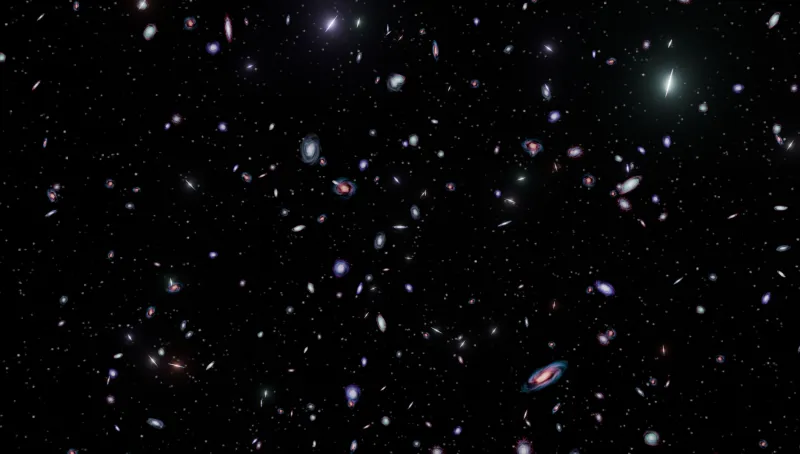
This is why astronomers talk about the observable universe as a distinct concept from the universe at large. The observable universe is the sphere around us from which light has had enough time to reach us since the Big Bang — roughly 93 billion light-years in diameter, which is already mind-bending given that the universe is only about 13.8 billion years old (the extra size comes from that same expansion).
Beyond the observable universe? We genuinely don't know. It could go on forever. It could be finite. There might be regions that look nothing like ours. We have no way to check, and barring some future physics we haven't imagined yet, we never will.
The observable universe isn't a limitation of our telescopes. It's a hard physical boundary baked into the structure of spacetime itself.
Getting Faster Over Time
Here's the part that really ought to keep you up at night: the expansion is accelerating.
In 1998, two independent research teams discovered that distant supernovae were farther away than they should have been if the universe's expansion were slowing down the way most physicists assumed it would. Gravity, after all, should be putting the brakes on. Instead, the expansion was speeding up.
Something is pushing it — something we've named dark energy, though that name is really just a placeholder for "we have no idea what this is." It makes up roughly 68% of the total energy content of the universe, and all we know for certain is that it's winning.
As the expansion accelerates, more and more galaxies will cross our cosmic event horizon. The universe we can see is gradually shrinking — not in size, but in scope. Billions of years from now, the Milky Way will have merged with Andromeda into one massive elliptical galaxy, and the rest of the universe beyond our local group will have receded so far that future astronomers — if there are any — will look out at what appears to be an empty universe and have no idea the Big Bang ever happened.
What This Means for Us, Right Now
There's something almost urgent about knowing this. The universe is more accessible to us today than it will be at any future point in cosmic history. Every year that passes, a few more photons that were heading our way from distant galaxies get swallowed by expansion before they can arrive.
We live in what cosmologists sometimes call the "golden age" of observational astronomy — a brief window in cosmic time when the universe is old enough to have formed complex structures but not yet so expanded that we've lost our view of them.
So no, the speed of light isn't being broken. The laws of physics are holding up just fine. What's happening is simultaneously more subtle and more astonishing: space itself is the thing doing the stretching, and it plays by different rules than the stuff inside it.
The universe isn't cheating. It's just bigger — and stranger — than the rules were designed to describe.