Light Is the Fastest Thing Alive — and It Still Can't Cross Our Neighborhood Quickly
Light Is the Fastest Thing Alive — and It Still Can't Cross Our Neighborhood Quickly
Here's a thought experiment. Imagine you could flip a switch and send a single beam of light — the fastest thing physics permits — on a journey across the universe. Not to some distant galaxy cluster billions of light-years away. Just across our local cosmic neighborhood. The Ursa Major Supercluster. Home.
How long do you think it would take?
If your gut said "pretty much instantly," you're in good company. Most of us carry around a vague sense that light is so fast it might as well be everywhere at once. But that intuition, it turns out, is one of the most spectacular lies our human-scaled brains tell us. The universe is not fast-friendly. And once you sit with the real numbers — not just read them, but feel them — the cosmos becomes a profoundly different place.
Let's take that journey, one leg at a time.
From Your Backyard to the Moon: 1.3 Seconds
Start close to home. The Moon hangs about 238,855 miles away on an average night — close enough that astronauts have been there, close enough that you can cover it with your thumb at arm's length. Light crosses that gap in roughly 1.3 seconds.
That's actually perceptible. During the Apollo missions, mission controllers in Houston experienced that exact delay when communicating with astronauts on the lunar surface. You'd ask a question, wait a beat, and then hear the reply. One-point-three seconds of emptiness between Earth and the Moon, filled with nothing but a photon racing at 186,282 miles per second.
That delay felt awkward in a conversation. In cosmic terms, it's basically zero.
Earth to the Sun: A Leisurely Eight Minutes
Now stretch outward. The Sun sits about 93 million miles from Earth — a distance so large that if you drove there at highway speed without stopping, it would take roughly 177 years. Light, though? Light makes the trip in about 8 minutes and 20 seconds.
Here's what that means in practical terms: every time you step outside and feel sunlight on your face, you're absorbing photons that left the solar surface while you were still drinking your morning coffee. The Sun you see right now is not the Sun as it currently exists. It's the Sun as it was eight-plus minutes ago.
This isn't philosophy. It's physics. And it gets stranger from here.
To Our Nearest Stellar Neighbor: Over Four Years
Proxima Centauri, the closest star to our Sun, sits about 4.24 light-years away. That unit — a light-year — is the distance light travels in a full Earth year. Do the math and that's roughly 25 trillion miles.
A beam of light leaving Proxima Centauri today won't reach your eyes for more than four years. If that star had a dramatic stellar flare this morning, you won't know about it until sometime around 2029. There's no way to know sooner. No signal, no shortcut, no workaround. The universe enforces its speed limit absolutely.
For context: NASA's Voyager 1 spacecraft, launched in 1977 and currently the most distant human-made object ever, has been traveling for nearly five decades and still hasn't reached even one light-year from Earth. At its current speed, it would take Voyager over 73,000 years to cover the distance light crosses in just four.
Let that settle for a moment.
Across the Milky Way: 100,000 Years of Nonstop Travel
Zoom out further. Our galaxy, the Milky Way, is a sprawling spiral roughly 100,000 light-years in diameter. A photon fired from one edge toward the other would still be traveling long after every civilization currently alive in the universe had risen, peaked, and vanished.
The light from stars on the far side of our own galaxy left before Homo sapiens existed. We are, in a very real sense, archaeologists of the sky. Every star we observe is a message from the past, and the farther away it is, the older that message.
Our entire recorded human history — every war, every empire, every invention from the wheel to the internet — fits inside a cosmic eyeblink compared to the time it takes light just to cross our galaxy.
The Local Group and Beyond: Millions of Years
The Milky Way isn't alone. It's part of a gravitationally bound collection of galaxies called the Local Group, which includes our nearest large galactic neighbor, the Andromeda Galaxy, sitting about 2.537 million light-years away. The light you can see from Andromeda on a clear, dark night left that galaxy before the earliest members of the genus Homo walked the African savanna.
You're not looking at a galaxy. You're looking at a fossil of light, 2.5 million years old, landing directly on your retina.
The Local Group itself spans roughly 10 million light-years. A signal sent from one end would arrive at the other end long after our Sun has burned out.
The Ursa Major Supercluster: Where Scale Becomes Surreal
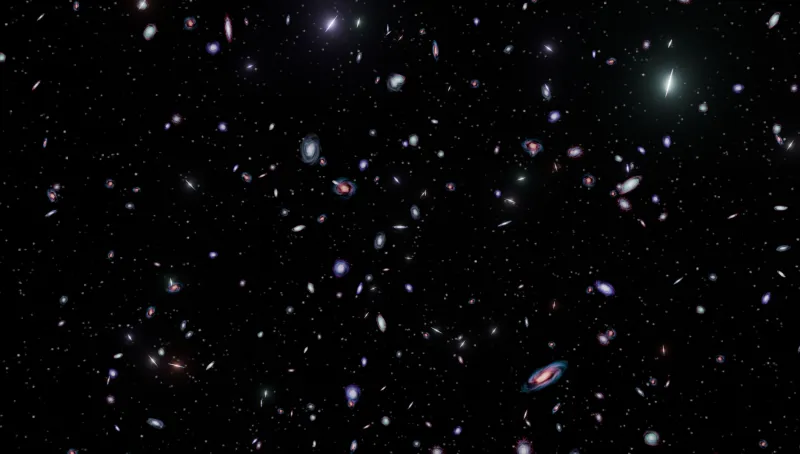
And then there's home base — the reason this website exists. The Ursa Major Supercluster is part of the vast large-scale structure of the universe, a region containing hundreds of galaxy groups and clusters spread across a volume that staggers the imagination.
Estimates place the broader supercluster environment we inhabit at somewhere on the order of hundreds of millions of light-years across. Even at the speed of light — the fastest speed anything can travel — crossing that expanse would take longer than the current age of the universe itself has elapsed since the Big Bang.
Read that again. A photon moving at maximum cosmic speed, from one side of our supercluster neighborhood to the other, would need more time than the universe has been around.
We don't live in a neighborhood. We live in an incomprehensible vault of space and time, and we've barely scratched the surface of understanding it.
Why This Actually Matters
None of this is just trivia. Understanding light-travel time reshapes how we think about everything we observe in the sky. When astronomers study distant galaxies, they're doing time travel — peering back toward the early universe, watching structures form that no longer exist in their observed form. The universe we see and the universe that currently is are two different things, separated by billions of years of cosmic evolution.
For backyard stargazers, this adds a layer of meaning to every clear night. That faint smudge of the Andromeda Galaxy you spot with binoculars? Ancient light, older than our species, completing a journey that started before the first humans ever looked up and wondered what those lights in the sky were.
We're the first generation in history to truly understand the scale of what we're looking at. And somehow, even knowing all of this, the universe still surprises us every time we look up.
That's not a reason to feel small. That's a reason to feel lucky.