Measuring the Unmeasurable: How Scientists Figure Out How Far Away Everything Is
Here's a question that sounds almost too simple: how do you measure the distance to something you can never visit, touch, or even send a signal to in any reasonable human lifetime? That's the puzzle astronomers have been wrestling with for centuries. And the solution they've built — piece by careful piece — is called the cosmic distance ladder.
It's not one technique. It's a whole staircase of them, each step resting on the one below it, carrying us from our own backyard all the way to the edge of the observable universe. Let's climb it together.
Step One: The Nearby Stuff (Parallax)
Start with something you can actually do with your own hand right now. Hold up your thumb, close your left eye, then your right eye. Notice how your thumb seems to jump against the background? That's parallax — the apparent shift in an object's position depending on where you're viewing it from.
Astronomers use the same trick, but instead of switching eyes, they use Earth itself as the baseline. As our planet orbits the Sun, nearby stars appear to shift slightly against the backdrop of much more distant stars. By measuring that tiny angular shift over six months — when Earth is on opposite sides of its orbit — scientists can calculate exactly how far away a star is using basic trigonometry.
This works beautifully for stars within a few thousand light-years. The European Space Agency's Gaia spacecraft has now mapped the parallax distances of over a billion stars with jaw-dropping precision. But here's the catch: the farther away a star is, the smaller the parallax shift gets, until it becomes too tiny to measure reliably. At that point, you need a new tool.
Step Two: Standard Candles and the Cepheid Solution
Imagine you're driving at night and you see a light in the distance. If you knew exactly how bright that light was supposed to be — say, a specific model of streetlamp — you could figure out how far away it is just by how dim it appears. The dimmer it looks, the farther away it must be. Astronomers call objects like this standard candles.
The first great cosmic standard candle was discovered by astronomer Henrietta Swan Leavitt in 1908. She was studying a class of pulsating stars called Cepheid variables, and she noticed something remarkable: the speed at which a Cepheid brightens and dims is directly tied to how intrinsically luminous it is. Slow pulse, brighter star. Fast pulse, dimmer star. Every time, like clockwork.
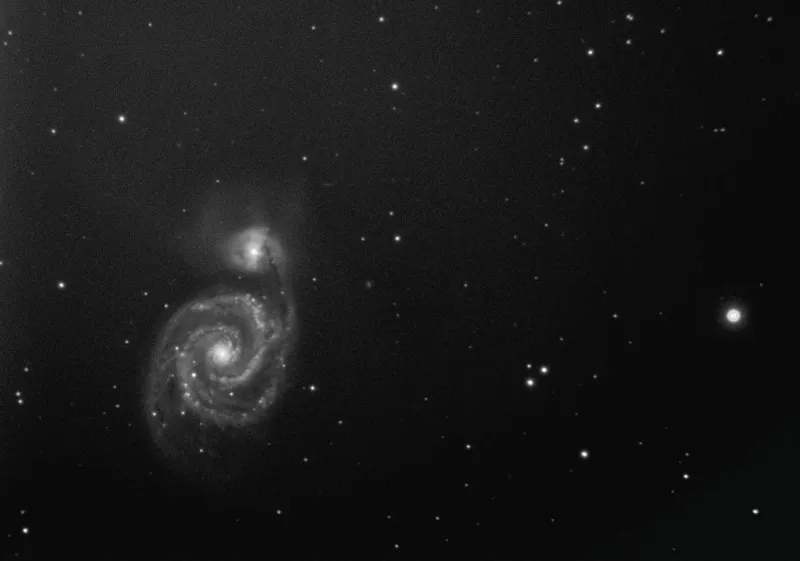
This was a game-changer. Once you know a Cepheid's true brightness from its pulse rate, and you can see how bright it appears from Earth, the distance practically calculates itself. Edwin Hubble used Cepheids in the 1920s to prove that the Andromeda "nebula" was actually a whole separate galaxy, millions of light-years away — a discovery that overnight expanded humanity's understanding of the universe by an almost incomprehensible factor.
Cepheids can carry us out to tens of millions of light-years. But even they eventually become too faint to detect. Time to climb again.
Step Three: The Universe's Brightest Explosions (Type Ia Supernovae)
When a certain type of white dwarf star accumulates too much mass from a companion star, it becomes unstable and explodes in a thermonuclear blast called a Type Ia supernova. These aren't just any explosions. They're remarkably consistent — nearly identical in peak brightness every single time they occur, anywhere in the universe.
That consistency makes them extraordinary standard candles, bright enough to be spotted across billions of light-years. By comparing how bright a Type Ia supernova appears versus how bright we know it actually is, astronomers can calculate distances to galaxies so remote that no other method could touch them.
It was Type Ia supernovae observations in the late 1990s that led to one of the most shocking discoveries in modern science: the expansion of the universe isn't slowing down — it's speeding up. That revelation earned the scientists involved a Nobel Prize and introduced the world to the concept of dark energy. Not bad for a measuring technique.
Where the Ladder Could Break
Here's the honest part of the story: the cosmic distance ladder is only as strong as its weakest rung. Each step is calibrated using the one below it, which means errors can compound as you climb higher. If your parallax measurements are slightly off, your Cepheid calibrations drift. If your Cepheid calibrations drift, your supernova distances drift further still.
This is actually at the heart of one of the biggest ongoing debates in cosmology right now — the so-called Hubble tension. When astronomers measure the current expansion rate of the universe using the distance ladder, they get a slightly different number than when they measure it using the cosmic microwave background (essentially, the afterglow of the Big Bang). The gap is small but stubbornly persistent, and scientists aren't sure yet whether it's a measurement error or a sign that our models of the universe are missing something fundamental.
It's the kind of problem that keeps astronomers up at night — in the best possible way.
Bringing It Home: How We Mapped Our Own Supercluster
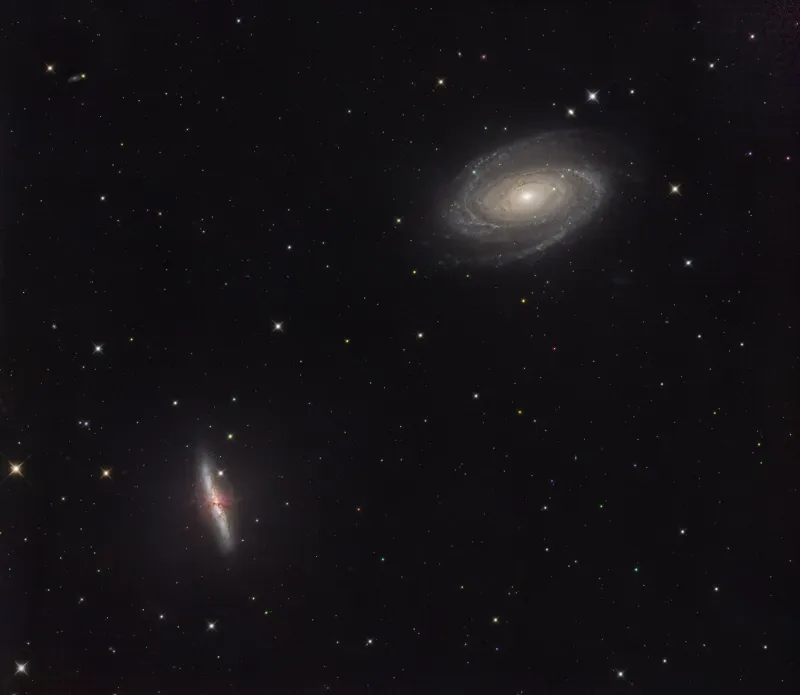
These same techniques are exactly how we know the scale of our own cosmic neighborhood — the Ursa Major Supercluster. The galaxies within and around it weren't mapped by spacecraft flying between them. They were mapped by patient, painstaking application of the distance ladder: parallax for nearby stars, Cepheids for closer galaxies, redshift measurements (a related technique using the Doppler-like stretching of light from receding galaxies) for the broader structure.
The result? We now know that the Ursa Major Supercluster spans roughly 200 million light-years. That number didn't come from guesswork. It came from a chain of clever measurements, each one building on the ingenuity of the people who came before.
The Bigger Picture
There's something genuinely inspiring about the cosmic distance ladder. Human beings — small, terrestrial, confined to one pale blue dot — have figured out how to measure the universe. Not by going there, but by thinking carefully about light, geometry, and physics.
Every time you look up at a star and wonder how far away it is, know that the answer exists. Scientists worked it out, one clever rung at a time. And they're still climbing.