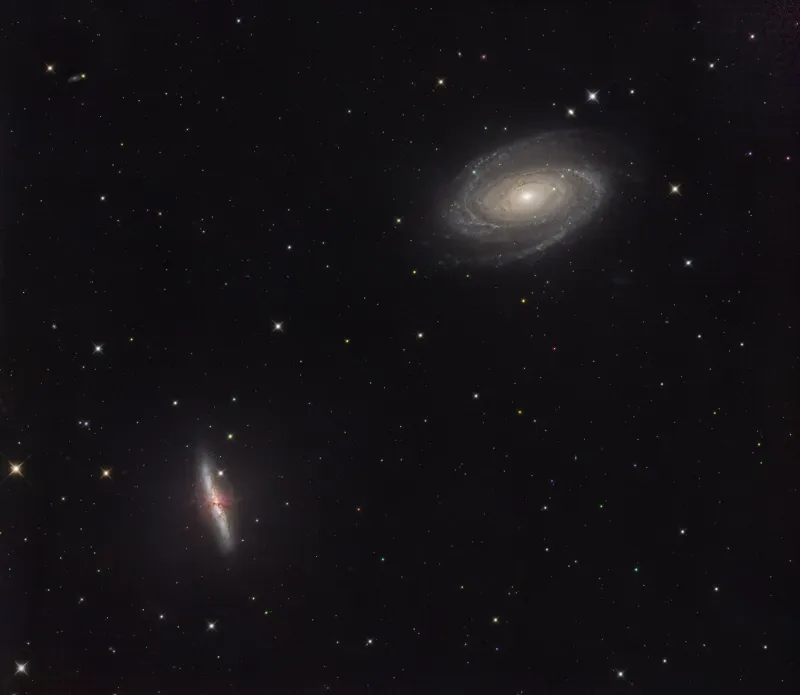
Cosmic Cannibalism in Slow Motion: Ursa Major Is Devouring Its Neighbors Right Now
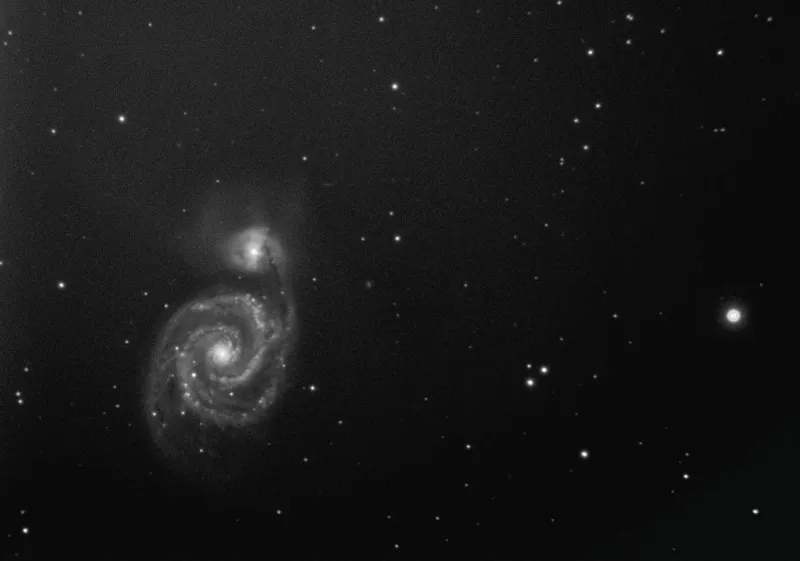
There's a common assumption that the night sky is permanent — that those familiar star patterns have always looked exactly the way they do tonight and always will. Constellations feel ancient and unchanging, like old photographs pinned to a dark ceiling. But zoom out far enough, and you'll find that the universe is anything but still. Galaxies are moving, colliding, stretching, and consuming each other in a slow-motion violence that plays out over hundreds of millions of years. And the neighborhood surrounding Ursa Major? It's one of the best front-row seats in the cosmos for watching this process unfold.
Astronomers call it galactic cannibalism. It sounds dramatic, but the term is scientifically accurate: large galaxies grow, at least in part, by gravitationally overpowering smaller dwarf galaxies and pulling them apart, absorbing their stars, gas, and dark matter over time. It's not a rare or exotic event. It's actually one of the primary ways that big galaxies like our own Milky Way got as big as they are.
What Galactic Cannibalism Actually Looks Like
Forget explosions. Forget the Hollywood version of cosmic destruction. Galactic cannibalism is subtle, patient, and almost eerily graceful. When a large galaxy's gravity begins tugging at a smaller neighbor, it doesn't crush it all at once. Instead, it stretches it — pulling stars from the outer edges first, drawing them into long, looping ribbons called tidal streams.
Think of it like taffy being pulled apart. The smaller galaxy gets elongated along the gravitational gradient of its larger host. Stars that were once loosely bound to the dwarf galaxy get stripped away and flung into wide, arcing orbits around the bigger galaxy. Over hundreds of millions of years, the dwarf galaxy is completely dismantled, its stars scattered through the outer halo of the cannibal galaxy like crumbs.
These tidal streams are ghostly things — diffuse, incredibly faint ribbons of stars spread across enormous stretches of sky. For most of astronomical history, we couldn't see them at all. It took the development of modern wide-field sky surveys with unprecedented sensitivity to finally reveal just how common they are.
The Evidence Written in Starlight
In recent years, surveys like the Sloan Digital Sky Survey (SDSS) and the Dark Energy Spectroscopic Instrument (DESI) have essentially given astronomers night-vision goggles for the low-surface-brightness universe — the dim, extended structures that older instruments completely missed. What they found was staggering.
The halos of large galaxies — including those in the Ursa Major region — are riddled with the ghostly remnants of consumed dwarf galaxies. Stellar streams wrap around galactic disks like half-dissolved ribbons. Shells of stars, created when a dwarf galaxy plunges through the center of a larger one, ripple outward in concentric arcs. The outer halos of big galaxies, it turns out, are essentially graveyards and recycling centers rolled into one.
The Milky Way itself shows clear evidence of this ongoing process. The Sagittarius Dwarf Galaxy is currently being torn apart by our galaxy's gravity, and its tidal stream loops around the Milky Way in a massive arc that spans much of the sky. But the Sagittarius stream is just the most famous example — there are others, and astronomers are still cataloging them.
In the broader Ursa Major region, the clustering of galaxies creates a particularly rich environment for these interactions. Dwarf galaxies in the group don't just orbit peacefully forever. They fall inward, get disrupted, and eventually merge into larger hosts. It's a process that's been going on since the first galaxies formed, and it's still going on right now.
Why Large Galaxies Are Built From Smaller Ones
This cannibalistic process isn't a cosmic accident — it's actually baked into the leading theory of how structure forms in the universe, called hierarchical structure formation. In this model, the early universe was filled with small clumps of matter that gradually merged together under gravity. Small structures formed first, then combined to build bigger ones. Dwarf galaxies were the building blocks. Large galaxies like the Milky Way or the massive ellipticals in galaxy clusters are, in a very real sense, the accumulated remains of thousands of smaller systems.
This has a fascinating implication: when you look at the stellar halo of a big galaxy — that diffuse cloud of old stars surrounding the main disk — you're essentially looking at a fossil record of every dwarf galaxy that galaxy has ever consumed. Different merger events leave different chemical signatures in the stars they contribute. By analyzing the ages, compositions, and orbits of halo stars, astronomers can actually reconstruct a galaxy's merger history, reading its past like growth rings in a tree.
For the Milky Way, this kind of galactic archaeology has revealed a surprisingly eventful history. A major merger event now called Gaia-Enceladus (named after the ESA mission that helped discover it) deposited a huge number of stars into our galaxy's inner halo roughly 10 billion years ago. It essentially shaped the inner structure of the Milky Way as we know it today.
What This Means for Our Future
Here's where things get personal. The Milky Way isn't done eating. The Large and Small Magellanic Clouds — those two irregular satellite galaxies visible from the Southern Hemisphere — are currently being gravitationally influenced by our galaxy. The Large Magellanic Cloud in particular is on a trajectory that, billions of years from now, will likely end in a full merger with the Milky Way.
And then there's Andromeda. Our nearest large galactic neighbor is approaching us at roughly 70 miles per second. In about 4.5 billion years, the Milky Way and Andromeda will collide in a merger event that will reshape both galaxies into something new — a massive elliptical galaxy that some astronomers have taken to calling Milkomeda. That event will be the most dramatic galactic cannibalism our galaxy has ever participated in, though none of us will be around to see it.
The Universe Is Always Becoming Something New
There's something quietly profound about all of this. The stars you see in Ursa Major tonight — and the dwarf galaxies being slowly absorbed in that region of space — are part of a process that has been reshaping the cosmos since nearly the beginning of time. Galaxies aren't static islands. They're dynamic, hungry systems constantly pulling in new material and building themselves up from the ruins of smaller neighbors.
The next time you step outside on a clear night and find the Big Dipper overhead, remember that you're not just looking at a fixed pattern of stars. You're looking at a neighborhood in the middle of an ongoing transformation — one measured not in years or centuries, but in billions of years of slow, relentless cosmic evolution.
The universe doesn't sit still. It never has. And honestly? That's what makes it worth watching.