Adrift in the Dark: The Stars That Were Thrown Out of Their Own Galaxies
Most of us carry a mental image of the galaxy as something orderly. Stars in their lanes, solar systems holding their orbits, everything more or less where it's supposed to be. It's a reasonable picture — and it's also incomplete.
Because some stars don't stay put. They get launched. Ejected from their birth clusters, hurled out of their home galaxies, sent tumbling through intergalactic space at speeds that make our fastest spacecraft look like they're standing still. These are the rogue stars — the wanderers — and their stories involve some of the most violent processes the universe has to offer.
The Mechanism: How a Star Gets Thrown Out
There's no single way to eject a star from its gravitational home, but the most dramatic involves the supermassive black hole at the center of a galaxy.
Here's the scenario. A binary star system — two stars orbiting each other — wanders too close to the galactic core. The black hole's gravity disrupts the pair, capturing one star into a tight orbit while flinging the other outward at an enormous velocity. This is called the Hills mechanism, named after astronomer Jack Hills who described it in 1988.
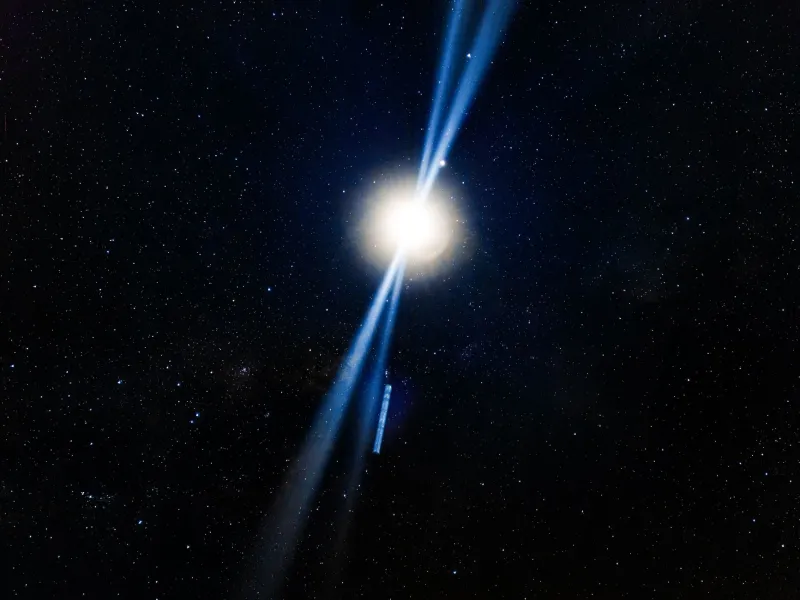
The speeds involved are staggering. Stars ejected this way can reach velocities of 1 to 3 million miles per hour — fast enough to escape the gravitational pull of the entire Milky Way. Astronomers call these hypervelocity stars, and the first confirmed example, a blue star designated HVS1, was discovered in 2005. It was traveling at roughly 1.5 million miles per hour, headed for the intergalactic void.
Since then, dozens of hypervelocity stars have been identified in and around the Milky Way, and the Gaia space observatory — a European Space Agency mission cataloguing the positions and motions of billions of stars — has turned up candidates that may have originated in other galaxies entirely.
Rogue Planets Are Just the Beginning
Before we go further, it's worth noting that rogue stars have smaller cousins: rogue planets, also called free-floating planets or interstellar planets. These are planetary-mass objects that were either ejected from their solar systems during gravitational tugs-of-war between planets, or possibly formed on their own in interstellar space without ever having a host star.
Estimates suggest there could be billions — possibly trillions — of rogue planets in the Milky Way alone. Some models put the number at multiple free-floating planets for every star in the galaxy. They're extraordinarily difficult to detect because they emit no light of their own, but gravitational microlensing surveys have found them by watching how their gravity briefly brightens background stars as they pass in front of them.
In 2023, the James Webb Space Telescope caused a stir by identifying a population of objects in the Orion Nebula that appeared to be planetary-mass objects traveling in pairs — dubbed "Jupiter Mass Binary Objects" or JuMBOs. Their origin is still debated, but they added a new wrinkle to the already complicated question of how these wandering objects form and travel.
The Intergalactic Crossing
For a hypervelocity star that has escaped its host galaxy, the journey ahead is almost incomprehensibly lonely.
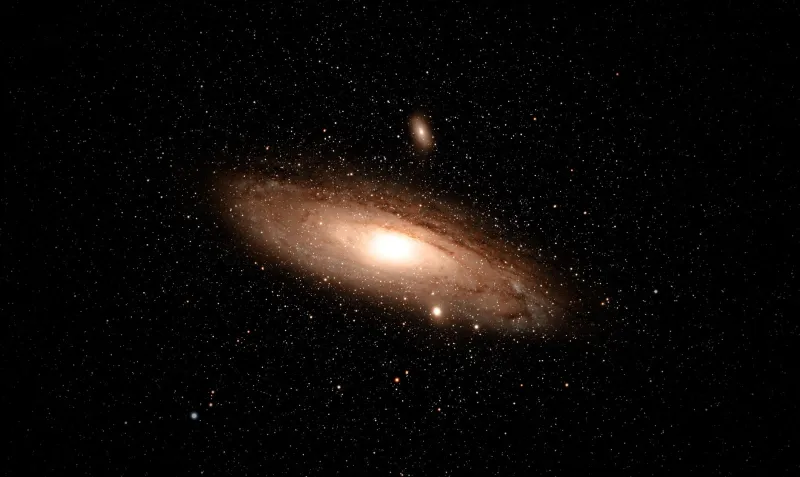
Intergalactic space is not quite empty — there's a thin, hot plasma out there, and the occasional rogue planet or dust grain — but for all practical purposes, a star crossing between galaxies is crossing an enormous, lightless void. The distance between the Milky Way and the Andromeda Galaxy, our nearest large neighbor, is about 2.5 million light-years. Even at 1.5 million miles per hour, a hypervelocity star would take billions of years to make that crossing.
During that time, it's dark. There's no galactic core providing a diffuse background glow. No nearby stars to cast light on any planets that might be traveling along. If a world somehow remained bound to a rogue star — which is possible, since the ejection process doesn't necessarily strip a star of its planetary system — it would exist in a kind of perpetual cosmic night, lit only by the wandering star itself.
The implications for life in such a scenario are genuinely strange to think about. A planet orbiting a rogue star in intergalactic space could theoretically maintain liquid water through the star's heat alone, insulated from the temperature of the surrounding void. It's a long shot, but the universe has surprised us before.
Stars From Other Galaxies, Already Here
One of the more mind-bending findings from the Gaia mission is that some stars currently in or near the Milky Way may have originated somewhere else entirely.
Analyzing the velocities and trajectories of stars in our galaxy's halo, researchers have identified candidates that appear to have been launched from the Large Magellanic Cloud — a satellite galaxy of the Milky Way — rather than from our own galactic center. If confirmed, these stars crossed hundreds of thousands of light-years of intergalactic space before arriving in our galactic neighborhood.
There are also stars in the Milky Way's halo that may trace their origins to ancient galaxy mergers — stars that belonged to smaller galaxies that the Milky Way absorbed billions of years ago. These aren't technically rogue stars in the traditional sense, but they're wanderers in a different way: immigrants from galaxies that no longer exist, now orbiting a home they never chose.
What the Wanderers Reveal
Rogue stars and hypervelocity stars are more than just fascinating objects in their own right. They're probes.
Because hypervelocity stars are launched from the galactic center, their trajectories carry information about the conditions there at the moment of ejection. By working backward from their current positions and velocities, astronomers can reconstruct details about the galactic core — its mass distribution, the behavior of the central black hole, the density of stars in the nucleus — that would be difficult to measure any other way.
Rogue planets, meanwhile, are helping researchers understand the chaotic early histories of planetary systems. The fact that so many worlds get ejected tells us that planetary formation is often a violent, unstable process — that the orderly solar system we live in may be the exception rather than the rule.
And for anyone who finds the night sky a little too comfortable, a little too familiar, there's something usefully humbling about the rogue stars. They remind us that the cosmos is not a static backdrop. Stars move. Systems dissolve. Entire worlds drift through the dark between galaxies, unattached to anything, for billions of years.
The universe is not tidy. It's just beautiful.