From Your Front Door to the Edge of Everything: Your Real Cosmic Address
You can probably rattle off your home address without thinking twice. Street number, city, state, zip — done. But here's a question almost nobody ever gets asked: what comes after the country? If you kept zooming out — past the atmosphere, past the moon, past everything familiar — what layers of structure would you pass through before you hit the edge of the largest thing humanity has ever mapped?
The answer is genuinely mind-bending, and it's the kind of thing that makes a Tuesday afternoon feel a little different once you really sit with it.
Start Small: The Solar System
Let's begin at home. Earth orbits the Sun at an average distance of about 93 million miles — a number so large it's almost meaningless until you consider this: light, the fastest thing in existence, still takes about eight minutes to make that trip. The solar system itself, counting out to the distant Oort Cloud where comets are born, stretches roughly two light-years across. That's your immediate neighborhood. Cozy, by cosmic standards.
Think of it like your house on a quiet street. Familiar. Manageable. But the street goes on.
The Milky Way: Your City
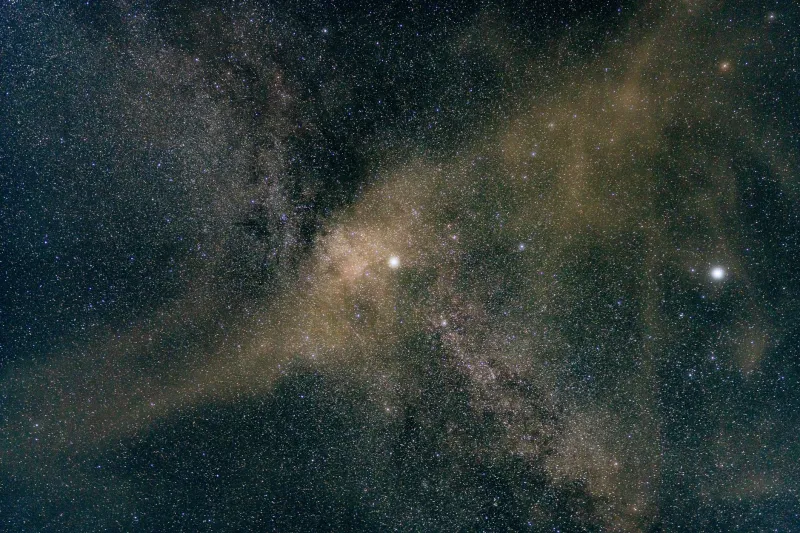
Zoom out far enough and the solar system becomes a single dot inside the Milky Way galaxy — a swirling collection of somewhere between 100 and 400 billion stars. Our Sun sits about 26,000 light-years from the galactic center, somewhere in the outer suburbs of one of the Milky Way's spiral arms. The whole galaxy is roughly 100,000 light-years across.
If the solar system is your house, the Milky Way is the city. A sprawling, messy, beautiful city full of stars being born, stars dying, black holes lurking at intersections, and clouds of gas drifting between it all like fog over the bay.
And just like any city, the Milky Way doesn't exist in isolation.
The Local Group: Your Metro Area
The Milky Way belongs to a small cluster of galaxies called the Local Group — about 54 galaxies bound together by gravity, spread across roughly 10 million light-years. The two heavyweights are us and Andromeda, a spiral galaxy about 2.5 million light-years away that's actually heading toward us at a few hundred kilometers per second. Don't panic: the collision is still about 4.5 billion years off.
The rest of the Local Group is mostly smaller satellite galaxies — the Large and Small Magellanic Clouds are the most famous, visible from the Southern Hemisphere as smudges of light in the night sky. The whole group is gravitationally bound, meaning these galaxies are connected to each other in a long-term cosmic relationship.
If the Milky Way is the city, the Local Group is the metro area. You don't live in every part of it, but you're definitely part of it.
The Virgo Supercluster: The Region
Zoom out further and the Local Group becomes one tiny node inside a larger structure called the Virgo Supercluster — sometimes called Laniakea, a Hawaiian word meaning "immeasurable heaven." This supercluster contains hundreds of galaxy groups and clusters, all loosely bound across a span of about 520 million light-years.
The Virgo Cluster itself — a dense knot of more than 1,300 galaxies — sits near the center of this structure, and our Local Group orbits somewhere out on the fringes. Astronomers only mapped the full shape of Laniakea in 2014, tracing the flow of galaxies through space like water draining toward a center point. The result was one of the most striking maps ever made: a vast, wispy web with our little corner clinging to one edge.
This is your region. The Virgo Supercluster is your state, maybe your time zone.
The Ursa Major Supercluster: Where Things Get Interesting
Here's where it gets personal — at least for this website.
The Ursa Major Supercluster is a large-scale filament of galaxy clusters and groups that includes the Ursa Major Cluster and several surrounding structures, extending across a significant portion of the observable universe's large-scale architecture. It's part of the broader cosmic web — the foam-like network of filaments, walls, and voids that makes up the universe at its largest scales.
Think of the cosmic web like a sponge. The dense parts — the filaments and walls — are where galaxies clump together. The empty spaces between them, called voids, are almost completely devoid of matter. The Ursa Major Supercluster sits along one of those dense filaments, a thread of structure billions of light-years long.
If Laniakea is your state, the Ursa Major Supercluster and the broader filamentary structure it belongs to is your country — and the cosmic web itself is the continent.
The Observable Universe: The Whole Planet
At the very top of this hierarchy sits the observable universe — everything we can currently detect, out to a radius of about 46 billion light-years in every direction. (Yes, that number is bigger than the age of the universe in light-years. Space has been expanding the whole time, which is a whole other rabbit hole.)
The observable universe contains an estimated two trillion galaxies. Two trillion. Each one a city unto itself.
And somewhere inside all of that — in one galaxy, on one arm of one spiral, orbiting one average star — is your house.
Why Any of This Matters
You might be wondering what any of this has to do with your actual life. Fair question.
Here's the honest answer: it doesn't change your Tuesday. But it does change how Tuesday feels if you let it. There's something quietly radical about understanding that your address doesn't end at a zip code — that you live inside a structure so large that light, traveling at 186,000 miles per second, would take hundreds of millions of years just to cross it.
You are not separate from the universe. You're made of the same atoms forged in ancient stars, living inside the same gravitational architecture that's been assembling itself since the Big Bang. Your cosmic address is absurdly long, and almost nobody knows it.
Now you do.