Built by Nothing: How an Invisible Force Assembled Every Galaxy in the Universe
Imagine hiring a contractor to build your house, and when you show up on move-in day, the whole thing is standing — framed, roofed, wired — but you never once saw the contractor. You have no photos, no receipts, no signature on any paperwork. All you have is the house itself, which wouldn't be standing without someone doing the work.
That's roughly the situation cosmologists find themselves in with dark matter. Nobody has ever caught it directly. No detector has ever pinged it. No telescope has ever photographed it. And yet, the universe as we know it — the spiral galaxies, the star clusters, the planets, and ultimately us — almost certainly couldn't exist without it.
So how did scientists become so convinced that something invisible is actually the most important structural ingredient in the cosmos? The answer is a detective story that spans decades, continents, and some of the most counterintuitive observations in the history of science.
The Stars That Refused to Slow Down
The first serious crack in the "we understand galaxies" narrative came in the 1970s, largely through the work of astronomer Vera Rubin. She was mapping the rotation speeds of stars inside spiral galaxies — a seemingly routine exercise that was supposed to confirm something basic: stars near the outer edges of a galaxy should orbit its center more slowly than stars near the middle, just like the outer planets in our solar system orbit the sun more slowly than Mercury does.
They didn't.
The stars at the outer edges were moving just as fast as the ones closer in. Sometimes faster. By every law of Newtonian gravity, that shouldn't happen. The visible matter in those galaxies — all the stars, gas, and dust you could actually see — didn't produce nearly enough gravitational pull to keep those outer stars from flying off into space.
The galaxy should have been flinging its edges apart. It wasn't. Something else was holding it together, something massive and spread out far beyond the visible disk of stars. Something that didn't emit or reflect any light.
Those flat rotation curves, as they're called, became one of the foundational pieces of evidence for dark matter. Not a quirk. Not a measurement error. A repeating signal across hundreds of galaxies that kept insisting: there's more here than meets the eye.
Gravity Bending Light in Ways It Shouldn't
If dark matter was just a galaxy-rotation problem, you might be able to explain it away. But then came gravitational lensing, and things got much harder to dismiss.
Einstein predicted — and we've since confirmed — that massive objects bend the light passing near them. A galaxy cluster sitting between us and something even farther away will warp that distant light into arcs and rings, acting like a cosmic magnifying glass. The degree of bending tells you how much mass is doing the bending.
When astronomers ran the numbers on galaxy clusters, the visible matter accounted for only a fraction of the bending they observed. The lensing was too strong. Way too strong. There had to be enormous quantities of invisible mass distributed throughout and around those clusters to produce the effect being measured.
One of the most striking examples is the Bullet Cluster — two galaxy clusters that passed through each other roughly 150 million years ago. When they collided, the hot gas (the majority of ordinary matter in galaxy clusters) got slowed down and left behind. But the gravitational lensing maps showed that most of the mass in each cluster had sailed right through the collision without slowing down at all, as if nothing had happened.
Ordinary matter interacts. Dark matter, apparently, does not — at least not with anything except gravity. The Bullet Cluster didn't just support the dark matter hypothesis. For many scientists, it was close to a smoking gun.
The Web That Holds Everything Together
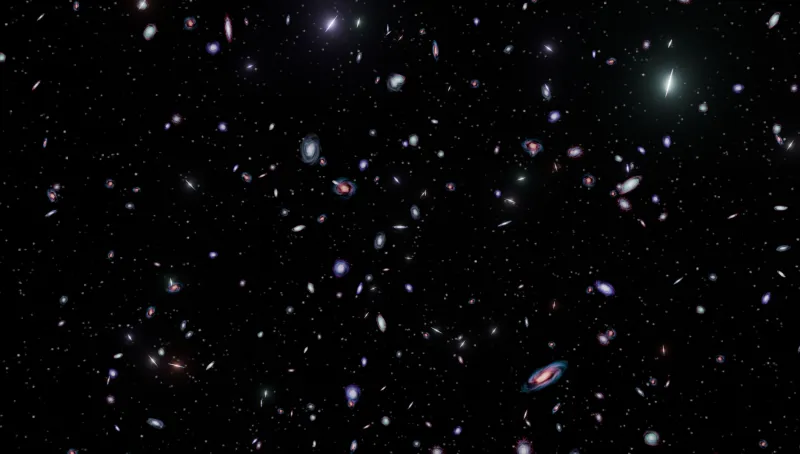
Zoom out far enough, and the universe isn't a random scattering of galaxies. It's a structure — a cosmic web of vast filaments, sheets, and nodes, with enormous voids in between. Galaxy clusters tend to gather at the intersections of those filaments, like cities at highway junctions.
Cosmological simulations — computer models that attempt to recreate the large-scale evolution of the universe — can only reproduce this web-like structure when dark matter is included. Run the simulation with only ordinary matter, and you get something that looks nothing like the universe we actually live in. The filaments don't form properly. The galaxy clusters don't clump in the right places. The whole architecture falls apart.
Add dark matter, and suddenly the simulation matches observation with remarkable precision. The web appears. The voids empty out. The clusters gather where they should.
This isn't just impressive. It's telling us something fundamental: dark matter wasn't a passive bystander in the early universe. It was the scaffold. The ordinary matter — hydrogen, helium, everything that would eventually become stars and planets and people — fell into the gravitational wells that dark matter had already dug. Without those wells, the gas wouldn't have clumped densely enough to collapse into stars. No stars means no heavier elements, no planets, no chemistry, no biology.
Dark matter didn't just shape the universe. It made the universe habitable.
A Mystery That Keeps Delivering
Here's the part that doesn't get enough attention: the fact that we haven't identified what dark matter actually is doesn't mean the science is stuck. In some ways, it means the science is thriving.
Researchers have narrowed the field considerably. Dark matter isn't ordinary matter hiding in some dim form we've overlooked — brown dwarfs, black holes, and other compact objects can't account for the observed effects at the necessary scale. It's almost certainly a new type of particle, or perhaps several, that interacts gravitationally but not electromagnetically. That's why it's invisible. Light, which is electromagnetic radiation, simply passes through it.
The leading candidates have names like WIMPs (Weakly Interacting Massive Particles) and axions, and there are experiments running right now — deep underground, in converted mines, in space-based observatories — trying to catch even a single interaction. So far, nothing. But the search is sharper and more sophisticated than it's ever been.
And in the meantime, the observational evidence keeps piling up. Every new galaxy survey, every gravitational lensing map, every cosmological simulation adds another line to a case that was already compelling decades ago.
The Contractor Nobody Sees
There's something almost poetic about the fact that the most important structural ingredient in the universe is the one we can't directly observe. We live in galaxies that dark matter assembled. We formed on a planet made of star material that dark matter gathered together. We look up at a night sky shaped entirely by a force we've never once measured in a laboratory.
That's not a gap in our knowledge to be embarrassed about. It's one of the most exciting open questions in all of science. The architect is out there. We just haven't figured out how to shake its hand yet.